
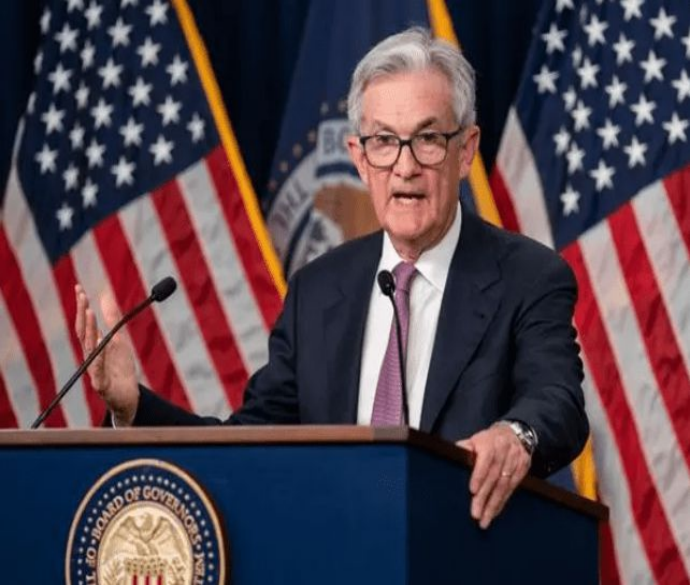
On the 23rd, the Chairman of the Federal Reserve, Jerome Powell, said that the time has come to adjust monetary policy. International observers believe that the decline in inflationary pressure and the weak job market in the United States are the main reasons why the Federal Reserve is ready to adjust its monetary policy. However, even if the Federal Reserve starts to cut interest rates, the high borrowing costs caused by high interest rates will continue for some time, continuing to drag down the development of the US economy. At the same time, the subsequent monetary policy direction of the Federal Reserve also brings great uncertainty to the global financial market and economic development.
Powell said at the Kansas City Fed's annual economic symposium in Jackson Hole, Wyoming, that the timing and pace of interest rate cuts will depend on the latest data, changes in the economic outlook and the balance of risks. Powell, who has always been cautious in his speech, rarely conveys such a straightforward message to the market.
To combat inflation, the Fed raised interest rates 11 times from March 2022 to July 2023, with a cumulative increase of 525 basis points. Over the past year, the Fed has maintained the target range for the federal funds rate between 5.25% and 5.5%, the highest level in 23 years.
Last year, Fed officials predicted three rate cuts this year. However, rate cuts were repeatedly postponed as progress in fighting inflation faltered in early 2024 and inflation rebounded. As inflation data began to steadily decline again, the Fed sensed the time for a policy shift.
Powell pointed out that inflation has fallen and the labor market is no longer overheated, and he is more confident that the inflation rate is continuing to return to the 2% target. The Fed's preferred inflation indicator, the personal consumption expenditure price index, has fallen from a peak of 7.1% in June 2022 to 2.5% in June this year.
While inflation is declining, the suppressive effect of the Federal Reserve's high interest rates on economic activities has gradually become apparent, among which the cooling of the real estate market and the softening of the labor market have attracted the most attention.
Powell said the labor market has cooled significantly and is unlikely to be a source of heightened inflationary pressures in the short term, and that the Fed "does not seek or want" further cooling in the labor market. He believes that the upward risk of inflation has weakened, while the downward risk of employment has increased.
Powell's concerns are justified. The Labor Department reported earlier this week that the monthly jobs report overestimated job growth in the 12 months through March, by about 818,000 jobs, suggesting the labor market is tighter than previously thought. Weak.
The latest data shows that U.S. job growth continues to slow. The monthly employment report released by the Labor Department in early August showed that the U.S. unemployment rate rose to the highest level since October 2021 in July.
Dean Baker, senior economist at the Center for Economic and Policy Research, previously told Xinhua News Agency reporters that the Federal Reserve has two major responsibilities: price stability and full employment. Unless there is a major surprise, the Federal Reserve will most likely cut interest rates in September.
However, it may take a long time for the interest rate cut to boost the economy. Ted Rossman, senior industry analyst at Silver Rate Network, said that from the consumer's perspective, the interest rate reduction will be a gradual process, and a 25 to 50 basis point interest rate cut may only bring about a small change in consumer borrowing costs. The interest rate reduction process may be much slower than the previous rapid interest rate increase process.
The latest data from the Chicago Mercantile Exchange's Federal Reserve Watch tool shows that as of the evening of the 22nd, the probability of the Federal Reserve cutting interest rates by 25 basis points at the September 17-18 interest rate meeting is 63.5%, and the probability of cutting interest rates by 50 basis points is 36.5%.
Currently, some economies are facing risks caused by differences between their own monetary policies and those of the Federal Reserve. Take Japan as an example. The Bank of Japan ended its negative interest rate policy in March this year, and announced an interest rate hike at the end of July against the backdrop of the Federal Reserve's expectations of a September rate cut. In early August, the two major stock indexes in Tokyo, Japan, plunged by more than 12%, triggering a "Black Monday" in global stock markets.
Hidetoshi Tashiro, chief economist at Japan Mugen Contract Co., Ltd., believes that the historic plunge in the Japanese stock market in early August was caused by a large number of yen carry trades rushing to close their positions and flee, but the fundamental reason lies in the Federal Reserve's monetary policy that disregards the interests of the whole world. After the Federal Reserve started the interest rate hike process in March 2022, the interest rate gap between the United States and Japan widened sharply, directly triggering this round of yen carry trades.
Humphrey Moshi, director of the Center for Chinese Studies at the University of Dar es Salaam in Tanzania, said that in March 2020, the Federal Reserve lowered interest rates to near zero to cope with the impact of the epidemic. Since March 2022, the Federal Reserve has begun to raise interest rates aggressively to cope with inflation. This drastic change in monetary policy has led to capital outflows, currency depreciation, and heavier debt burdens in some developing countries. The Federal Reserve does not consider the impact on other economies, especially developing countries, when formulating monetary policy, which has exacerbated the economic difficulties of some countries.