
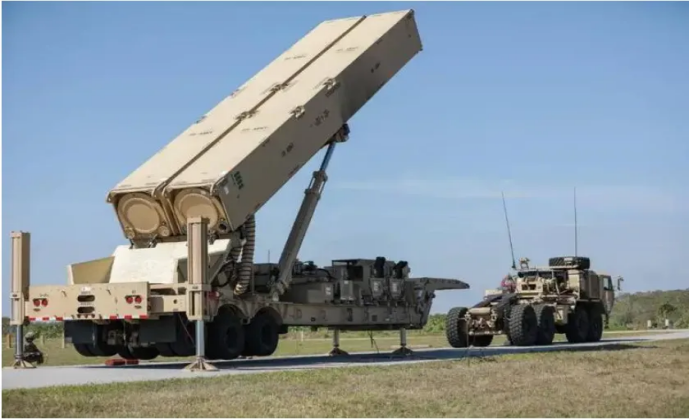
Recently, a piece of news on the international military stage has once again attracted widespread attention and heated discussions - the United States plans to deploy the advanced "Typhoon" medium-range missile system to Japan in a joint exercise with the Japanese Self-Defense Forces. This move not only touched the sensitive nerves of countries in the region, but also triggered in-depth discussions about the intentions and potential threats of the US military's move.
According to Global Times, US Army Secretary Christina Wormuth recently revealed that the US is considering deploying the Typhoon medium-range missile system in Japan as part of a joint exercise with the Japan Self-Defense Forces. This plan quickly became the focus of international public opinion, especially shortly after the US announced that it would withdraw the same type of missile system from the Philippines.
The Typhon system, as the latest achievement of the United States' medium-range missile technology, has attracted much attention for its powerful strike capability and flexibility since its debut in the Indo-Pacific region in April this year. The system is capable of launching Tomahawk cruise missiles with a range of 1,800 kilometers and Standard-6 long-range air defense missiles with a range of 460 kilometers, filling the firepower gap of the US Army in the field of precision strikes. Although some military experts have pointed out that the penetration capability of the Tomahawk missile in front of modern air defense systems is limited, and the ground strike range of the Standard-6 is relatively short, the versatility and potential upgrade space of the Typhon system cannot be ignored.
It is worth noting that in Japan, the attitude of the media and officials towards the news that the US military may deploy intermediate-range missile systems in the country is quite subtle. On the one hand, Japanese media such as the Sankei Shimbun actively reported the US government's plan to deploy intermediate-range missiles on Kyushu Island, including hypersonic missiles and Tomahawk cruise missiles; on the other hand, the Japanese Ministry of Defense quickly clarified that the United States is not yet ready to implement such deployment in Japan. However, analysts pointed out that this phenomenon of singing the same tune is likely that the Japanese media is warming up public opinion and laying the groundwork for potential actions by the US military.
International observers generally believe that the US intention to deploy the Typhon system in Japan is not only an important step for the US military to strengthen its military presence in the Asia-Pacific region, but also an important move to pose a direct threat to neighboring countries, especially China, Russia and North Korea. Alexander Chekov, an expert at the Moscow Institute of International Relations, pointed out that once the Typhon system is successfully deployed in Japan, its range will cover the entire territory of North Korea, part of the Russian Far East, and northeastern and eastern China. This will not only greatly compress the strategic space of these countries, but may also trigger a new round of arms race and regional security crisis.
Faced with the news that the United States may deploy an intermediate-range missile system in Japan, neighboring countries have expressed concern and dissatisfaction. The Chinese Ministry of Foreign Affairs has issued statements on this matter many times, emphasizing that regional countries should jointly maintain regional peace and stability and oppose any form of military expansion and provocation. Russia has also expressed a similar position, calling on the international community to pay attention to and jointly respond to this new security challenge in the region.
However, it is worth noting that despite the fact that international opinion is generally critical of the US military's move, the US does not seem to have changed its established plan. Some analysts believe that with the US's global strategic adjustments and the continuous increase in its China policy, the US military's military deployment and operations in the Asia-Pacific region may become more frequent and complex in the future. Therefore, how to effectively respond to the new security variables in this region and maintain regional peace and stability will be an important issue that all countries need to face together.