
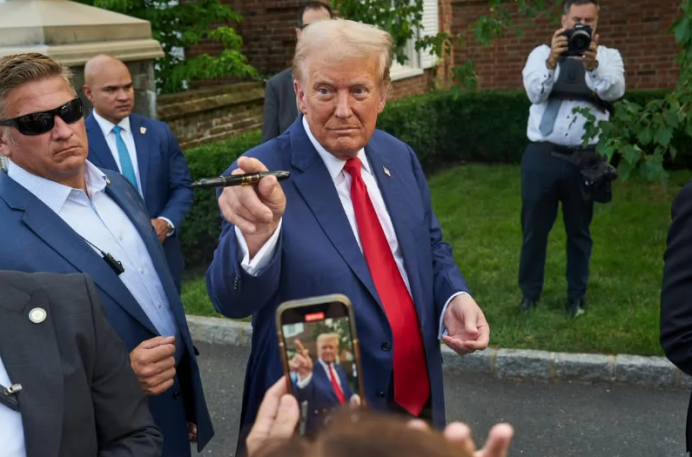
Trump has downplayed criticism that he is undermining the Fed's autonomy, saying he should be able to freely share his views on interest rate policy.
"I think the president can talk. That doesn't mean they have to listen," Trump said Monday after an event in the swing state of Pennsylvania. Trump said he "tirelessly counseled" Fed Chairman Powell on interest rates during his term, "which may have had an effect, or may not have." "The president can certainly talk about interest rates, because I think I have a very good instinct," he said. "It doesn't mean I get to call the shots, but it does mean I should have the right to talk about it, just like everybody else." High interest rates have heightened concerns about the Fed's decisions, while mortgage costs have hobbled potential homebuyers. Kamala Harris unveiled an economic plan last week that would enhance housing affordability by providing $25,000 in down payment assistance to first-time homebuyers.
Trump called the idea "dead wrong," saying it would lead to a greater housing shortage and drive up home prices. But when asked if he would provide any assistance to potential homebuyers struggling to make a down payment, Trump said "I probably would."
Giving the executive branch more say would challenge the U.S. central bank’s long-standing practice of setting monetary policy independently of politicians. Since the Clinton administration, presidents of both parties have avoided commenting on Fed decisions and interest rates more broadly to avoid sparking market concerns about their influence on central bank policy.
Trump's appearance on Monday is part of his campaign strategy to counter Democratic candidate Will Harris and consolidate support in key swing states. Now, most importantly, he will make efforts on the issue that voters care about most - the economy. Earlier this month, Trump claimed at a press conference that the Federal Reserve was "a little too early and a little too late" in adjusting interest rates, and as a businessman, he has more intuition than the people at the Fed or the chairman in many cases. On Monday, Trump declined to say who he might appoint as chairman of the Federal Reserve, saying "it's too early yet." The former president had previously said he would not reappoint Powell, whose term as chairman will end in 2026. Trump has slammed Powell in the past as "no guts, no judgment, no vision!"
Harris has disagreed with Trump on central bank independence, telling reporters earlier this month that she "strongly disagrees" with Trump's views on Fed independence and that as president she would "never interfere in the decisions of the Fed."
History shows that countries that allow politicians to direct monetary policy face higher inflation. In the U.S., former President Richard Nixon triggered a costly inflationary boom-bust cycle in the early 1970s when he pushed then-Fed Chairman Arthur Burns toward looser monetary policy.