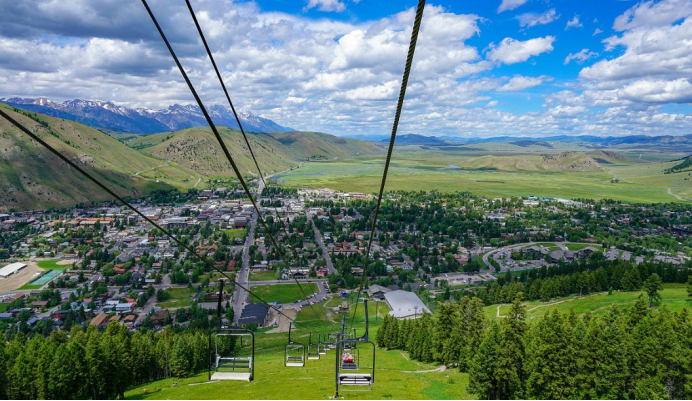
Federal Reserve Chairman Jerome Powell will deliver a keynote speech during the annual central bank symposium in Jackson Hole, Wyoming, U.S. Wall Street expects Powell to use the opportunity to confirm that the Fed will cut interest rates, and the focus of stock traders' debate has shifted from whether the Fed will or will cut interest rates to how much the Fed will cut.
Eric Beiley, executive managing director of wealth management at Steward Partners Global Advisory, said:
“If traders hear that rate cuts are coming, the stock market will react positively. If they don’t hear what we want to hear, it will trigger a massive sell-off,” he said. “The market is very confident that rate cuts will come soon. It would be a surprise if Powell didn’t emphasize that this is the path forward.”
Simon White, a macro strategist at Bloomberg, believes that Powell has the opportunity this week to emphasize that the risk of a near-term recession in the U.S. stock market is limited, thereby further reducing the risk of asset prices being negatively affected by the economy. He will undoubtedly emphasize the dependence of the Fed's response function on data, but he can also emphasize the relative health of the U.S. economy, thereby reducing the risk of the market triggering a feedback loop due to recession. The extent of the rate cut expected by the market still seems to be vulnerable to repricing.
But some Wall Street professionals warned investors not to expect Powell to give too much clarity. For example, Tom Hainlin, national investment strategist at US Bank Wealth Management, said: "Looking back at past speeches at Jackson Hole, we are unlikely to get very clear comments from Powell."
Some people believe that the key to maintaining market sentiment is not what Powell said, but his tone. Stephanie Lang, chief investment officer of Homrich Berg, said: "His (Powell's) tone is crucial. If his remarks shock the market and his attitude is tough, the stock market will react negatively."
William Dudley, former third-in-command of the Federal Reserve and president of the New York Fed from 2009 to 2018, said Powell may hint that tight monetary policy is no longer necessary, but will not hint at how big the first rate cut will be, especially considering the non-farm payroll report to be released on September 6. Fed officials will have to take this important report into consideration before making decisions at the next Fed meeting on September 18.
Currently, traders generally expect the Fed to cut interest rates by September, but they are not sure by how much. With few public speeches from Fed officials in the first few days of this week, Powell's remarks on Friday are particularly important. Citi believes that this is why options traders expect the S&P 500 to move more than 1% in either direction on Friday, a forecast based on the cost of at-the-money call and put options.
Last week, Wall Street News mentioned that in recent years, the U.S. stock market has often experienced huge shocks around Powell's speeches at the Jackson Hole Annual Meeting. For example, in 2022, Powell's speech scared the U.S. stock market. In just 9 minutes, the theme of "pain" directly caused the three major U.S. stock indexes to plummet by 3%-4% that day. The market was also turbulent in 2023, but it happened on Thursday, the day before Powell's speech. The Dow Jones Industrial Average recorded its largest point drop in five months that day, and the Nasdaq fell nearly 2%.
On Monday, there were comments that traders have cut bets on a sharp rate cut in September, with a cut of about 30 basis points expected in September, due to signs of economic resilience. Hainlin said this means that the market risks brought by the Jackson Hole meeting are fading and investors are no longer expecting a sharp rate cut. He said: "We want to know what the Fed's interest rate path actually looks like, whether it will be a rate cut at each meeting, or whether it still depends on employment and inflation data. But he (Powell) may not say that. Traders are more likely to get this information through the Fed's September meeting . "