
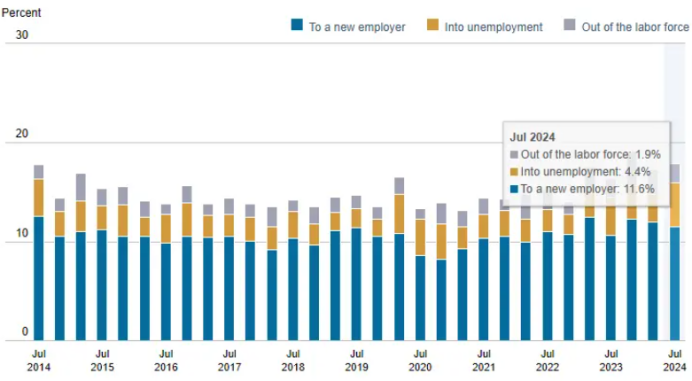
On Monday (August 19th) local time, the New York Fed's Microeconomic Data Center released the labor market survey report of the Consumer Expectations Survey (SCE) in July 2024. The results showed that the proportion of respondents who believed they might be unemployed in the next four months reached the highest level since the survey was conducted in 2014; at the same time, the number of people who expected to receive job offers in the next few months also increased compared with the same period last year.
Overall, the content of this survey report by the New York Fed means that the mobility of the U.S. labor market is increasing, and more and more workers are dissatisfied with their wages and bonuses and continue to maintain their expectations for high salaries.
The non-farm report earlier this month showed that the U.S. unemployment rate unexpectedly rose to 4.3% in July, reaching the highest level since October 2021, triggering the "Sam Rule". Historically, this rule has been verified in all nine U.S. recessions since 1960. This has made economists and monetary policymakers highly alert to any signs that the labor market may deteriorate faster than expected.
The July survey found 4.4% of respondents expected they would lose their job in the next four months, the highest level on record; but that was still smaller than the proportion of those who expected to move to a new position, which rose to 11.6%.
The report highlighted increased employee mobility, with the share of people moving to a different employer rising to 7.1% - the highest level in the survey's history - while the share of respondents who were employed four months ago still working for the same employer hit an all-time low of 88%.
The analysis suggests that workers are dissatisfied with their jobs and looking for other opportunities, but advancement opportunities have worsened, especially for women, people without college degrees and households earning less than $60,000 a year.
Despite increased mobility, workers are holding on to their salary expectations. The minimum wage for new jobs remains near an all-time high at just over $81,000, which is an increase of nearly $20,000 from March 2020 levels. Women's salary demands have grown faster than men's in recent years, but men's salary expectations are still significantly higher. In the latest survey released on Monday, men's expected salary was $94,500, while women's was $66,400.
More and more workers are expected to work longer. The report showed that the proportion of people who are likely to work until they are 62 or older has rebounded to 48.3% from a record low of 45.8% in the March 2024 survey, and the proportion who are expected to work until they are 67 or older has also increased.