
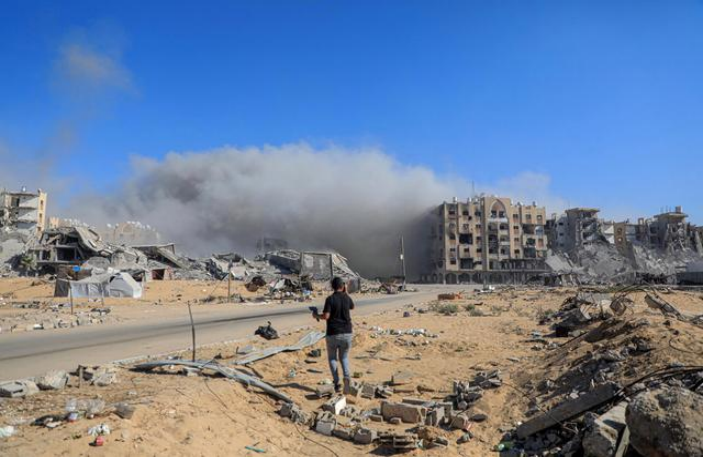
US Secretary of State Blinken said recently that Israel has accepted the US's transitional proposal for a ceasefire in the Gaza Strip, and he urged Hamas to accept the proposal. Hamas accused the proposal of only responding to Israel's demands and that Israeli Prime Minister Netanyahu should be "fully responsible" for undermining mediation efforts.
Blinken is visiting Israel and will travel to Egypt and Qatar this week to continue consultations on ceasefire negotiations. The Associated Press reported that Blinken said in an interview with the media after the meeting with Netanyahu that his meeting with Netanyahu was "very constructive", Israel supports the transitional proposal, and will send a negotiation team to participate in the ceasefire negotiations held in Cairo, the capital of Egypt this week.
Netanyahu expressed his gratitude to the United States for its "understanding of Israel's important security interests" that day, and said that he would strive to release as many detained Israeli personnel as possible in the first phase of the ceasefire agreement. A new round of ceasefire negotiations in the Gaza Strip was held in Doha, the capital of Qatar, with Israeli, American, Qatari and Egyptian negotiators attending. Hamas did not send a representative to participate, and the mediator "delivered the message". The ceasefire negotiations were suspended and will continue in Cairo this week. On the day when the negotiations were suspended, the United States submitted a transitional proposal based on the main points of the previous ceasefire plan, saying that the proposal would help bridge the differences between Israel and Hamas and help promote the two sides to quickly implement the relevant consensus after reaching a ceasefire agreement.
Blinken said the "important next step is getting Hamas to agree" to the transitional proposal, pressing for a ceasefire as the "single fastest, best, most effective way to end the suffering of the Palestinians."
Osama Hamdan, a member of the Hamas Political Bureau, previously stated that although the Palestinians have suffered tremendously in this round of Israeli-Palestinian conflict and are eager for a ceasefire, Hamas will not easily give up its demands because "ceasefire is not the same as surrender."
In an interview with Reuters, Blinken said that Israel accepted the ceasefire, but Israel said there was a new plan, which means that the United States was pressured by Israel, not putting pressure on Israel. "We think this is a trick to give Israel more time." According to Hamdan, what Hamas needs is not ceasefire negotiations, but the parties concerned to reach an agreement on the "implementation mechanism" of the ceasefire agreement. He also confirmed that the leader of the Hamas Political Bureau, Yahya Sinwar, has participated in Hamas's negotiation decision-making process. At present, the "tools and mechanisms" set up for communication with Sinwar for security reasons are running smoothly. In Gaza City in the northern Gaza Strip, people held a funeral for the victims of the Israeli army attack.
Hamas accused the mediators of making a proposal that was a compromise with Israel and was only "in response to Netanyahu's demands" in a statement. It also accused Netanyahu of wanting to delay the conflict and continuing to create obstacles to a ceasefire agreement.
After the outbreak of the current round of Israeli-Palestinian conflict, Israel and Hamas briefly ceased fire in November last year, but negotiations on a new ceasefire and the release of detained persons have been held for several rounds, but no breakthrough has been made so far. The two sides are deadlocked over issues such as Israel's insistence that the end of the conflict is premised on the elimination of Hamas and Hamas's acceptance of a permanent rather than temporary ceasefire. It is said that during the ceasefire negotiations in Cairo this week, the parties may reach a security mechanism for the "Philadelphia Corridor" bordering the Gaza Strip and Egypt. According to the source, the US proposed to impose international supervision on the area, and if the maximum period of this measure is set at 6 months, the relevant parties may accept it.