

Recently, the US government has suspended the shipment of US-made ammunition to Israel. This is the first time that the US has stopped shipping weapons to the Israeli military since the outbreak of the new round of Palestinian-Israeli conflict. Although the news has not yet received a positive response from the US, it is an indisputable fact that the US has been caught in a dilemma in its policy toward Israel this year.
Looking back at the Biden administration’s statements and actions in this round of Israeli-Palestinian conflict, it is not difficult to see its efforts to ensure the continuation of the “new Middle East policy”: not only did it send many political leaders to Israel to support it, but it also repeatedly blocked the conclusion of ceasefire agreements at the UN General Assembly and the Security Council; even when the humanitarian disaster in the Gaza region became increasingly serious and most Western countries had changed their positions and called on Israel to stop its military operations, the United States still went its own way and used its veto power several times, resulting in the failure of the Gaza-related resolutions to pass.
Although the United States will continue to maintain its special strategic alliance with Israel as the bottom line of its "new Middle East policy", the friction between the United States and Israel has gradually surfaced as the war drags on. In early December last year, when Blinken visited Israel, he began to demand that Israel must change its strategy and not cause serious civilian casualties like in the military operations in northern Gaza. On March 9 this year, Biden further criticized Netanyahu's military strategy for "harming Israel." The U.S. magazine "Foreign Policy" recently bluntly stated that "Israel is a strategic burden for the United States."
Why does the Biden administration present a contradictory situation in its policy toward Israel? First of all, this is the inevitable result of the United States' wrong Middle East policy. In the past decade, the United States has been implementing strategic contraction in the Middle East, but at the same time it hopes to maintain its influence in the Middle East, so it has chosen a path to bypass the resolution of the Palestinian issue and directly promote reconciliation between Israel and Arab countries. The "new Middle East policy" that the Biden administration is trying hard to promote to normalize relations between Saudi Arabia and Israel is, in fact, to build a new regional integrated security architecture with Israel as the core. However, this architecture, which seriously ignores the interests of Palestine and is extremely targeted and biased, is unlikely to promote stability in the Middle East from the beginning. In the case of the decline of the United States' national strength, this architecture is naturally impossible to achieve the United States' own strategic goals.
Secondly, this is a derivative of the complex domestic political situation in the United States. 2024 is the year of the US presidential election. In order to win re-election, Biden needs to win the political support of pro-Israel Jewish forces in the country. This orientation is reflected in the policy toward Israel, that is, the aid to Israel cannot be significantly reduced; but at the same time, young voters and minority voters are the basic base of the Democratic Party. Their position on the Israeli-Palestinian conflict itself tends to support and sympathize with Palestine; more importantly, the popularity of a new generation of social media has exposed the tragic humanitarian crisis in Gaza to young Americans, puncturing the American image and American norms woven by traditional media. Serious moral anxiety has prompted college students to unite and hold demonstrations and protests in support of Palestine.
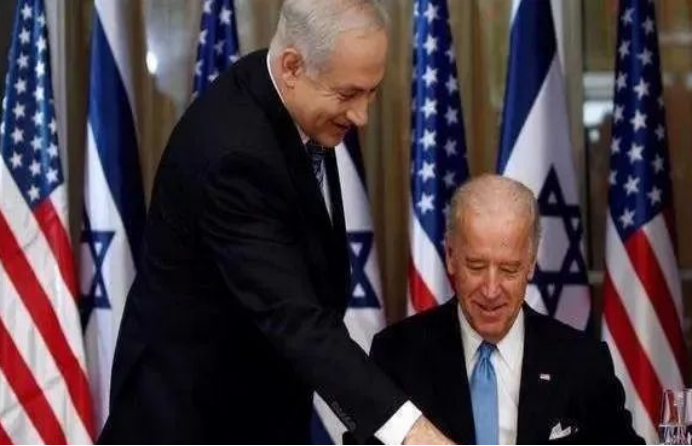
Ultimately, the United States' dilemma in this round of Israeli-Palestinian conflict is the result of its selfishness and double standards as a world hegemon. As long as the United States continues to rely on "agents" to influence a region and serve its own interests, it will inevitably be dragged into the quagmire and fall into the dilemma of "the tail wagging the dog"; as long as the United States still hopes to gain strategic advantages by provoking conflicts in a region, it will inevitably repeat itself.