
Top U.S. election security officials are asking American voters to tune out the noise and reject what they say are unfounded claims that the 2024 presidential election will be rigged.
On the other hand, in the first of a series of election security briefings planned in the run-up to the November election, they said American voters should have confidence that their votes will be accurately counted when they go to the polls. "You're going to hear a lot of different things from different sources over the next few months. What's most important is identifying the signal through the noise and fact from fiction," said Jen Easterly, director of the U.S. Cybersecurity and Infrastructure Security Agency (CISA), which oversees election security. "Our election process, our election infrastructure, has never been more secure and our community of election stakeholders has never been stronger," Easterly said during a briefing with reporters Tuesday. "That's why I have confidence in the integrity of our elections and why the American people should too." Easterly's efforts to reassure voters come more than a month after the U.S. intelligence community issued its own warning that U.S. adversaries, led by Russia and Iran, are seeking to interfere in the November election.
But efforts like those highlighted in the intelligence community warnings are led by influence operations or disinformation campaigns designed to sow doubt about the U.S. electoral process and help or hinder certain candidates.
By contrast, efforts by U.S. adversaries to attack or hack the systems used to conduct elections and count votes have so far been nonexistent. “We have not seen any intent to interfere with the election process,” Cait Conley, a senior adviser at the Cybersecurity and Infrastructure Security Agency, told reporters. While some of that can be explained by what officials say are ongoing investments in election security infrastructure — including the hiring of more field offices and election security advisers — Cybersecurity and Infrastructure Security Agency officials are not taking the absence of malicious activity for granted. “That’s something that’s subject to change,” Conley said. “As we look at the threat landscape for this election cycle, it really is arguably the most sophisticated yet.”
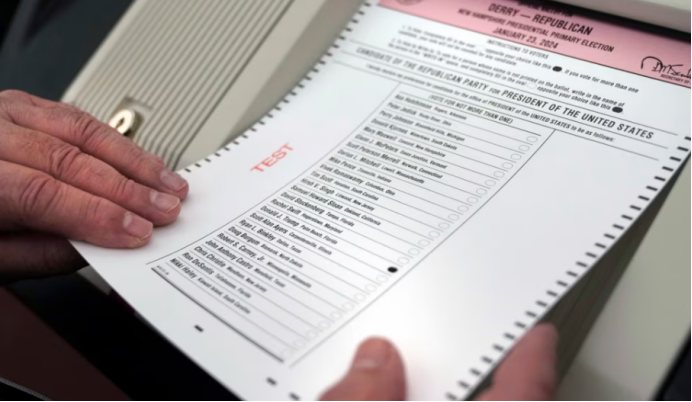
The Cybersecurity and Infrastructure Security Agency said other efforts to protect the upcoming presidential election include various election security exercises, accuracy testing of voting machines, and enhanced security measures to protect election-related computer networks. They also stressed that none of the systems recording votes are connected to the internet, and that 97% of American voters will vote in jurisdictions that use paper ballots as a backup.
Yet none of that has stopped countries like Russia, Iran and China from trying to convince voters that things are going wrong. One of the biggest concerns, Easterly said, is that America’s adversaries will portray minor glitches as major scandals. “Almost inevitably, somewhere across the country will forget to bring the key to the lock at a polling place,” she said. “Someone will unplug the printer and plug in the slow cooker. A storm could cause a polling place to lose power.”
The best way to avoid unnecessary panic is for American voters to rely on state and local election officials for information, Easterly and Conley said. But if Americans rely on word-of-mouth social media accounts, it could cause trouble. "This is a difficult problem for social media companies," a senior U.S. intelligence official said at a recent briefing. The official spoke on condition of anonymity to discuss sensitive matters. Graphika said it had found more than a dozen accounts on platforms including X (formerly Twitter) and TikTok that "claim to be U.S. citizens and advocates for peace, human rights and information integrity who are concerned about the United States and frustrated with U.S. politics and the West."
"These accounts spread and amplified content that denigrated Democratic and Republican candidates, sowed doubt about the legitimacy of the U.S. electoral process, and spread divisive narratives on sensitive social issues," Graphika reported. However, it added that few accounts were able to gain much attention. "Despite using a large number of accounts and platforms, Spamouflage has struggled to rise above its own 'fake' echo chamber," Meta said at the time. "Only a few instances have been reported when Spamouflage's content on Twitter and YouTube has been amplified by real-world influencers."