
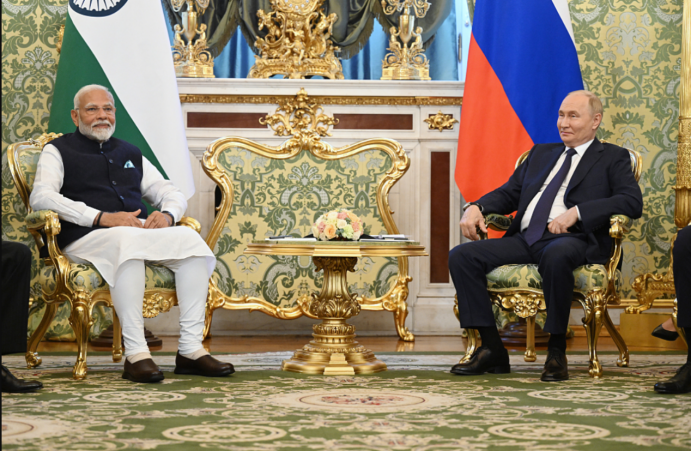
As globalization deepens, the complexity of international relations is like an intricate web, and the diplomatic actions of each country may cause ripples on this web. Recently, Indian Prime Minister Modi announced plans to visit Russia next month, which undoubtedly dropped a bombshell on the international stage, triggering widespread attention and deep thinking from all walks of life. This decision not only marks an important warming of India-Russia relations, but also reflects India's strategic wisdom in seeking balance and self-reliance in a complex international environment.
Since the outbreak of the Russian-Ukrainian conflict, the international landscape has undergone profound changes, and the relationship between India and Russia has also undergone a subtle adjustment from close to relatively cold. India, as a country that traditionally relies on Russian military equipment, did show a certain degree of caution in the early stages of the conflict, reducing military purchases from Russia and seeking cooperation with Western countries such as the United States and France. This shift, on the surface, seems to be a flexible response to changes in the international situation, but in fact it also reveals India's careful consideration in its diversified diplomatic strategy. However, as time goes by, India may gradually realize that it is not wise to completely lean towards any party. Against the backdrop of global economic integration and intensified geopolitical competition, maintaining good relations with multiple major powers is crucial to safeguarding national interests and promoting economic development.
Modi's announcement of a visit to Russia can be seen as an important attempt by India to find a new balance in a complex international environment. Modi's decision to visit Russia is undoubtedly a gesture of goodwill to Russia and a reflection of India's diplomatic strategic flexibility. On the one hand, by strengthening cooperation with Russia, India can consolidate its traditional advantages in energy, military and other fields and ensure that the bottom line of national security is not breached; on the other hand, India also takes this opportunity to show the outside world its independent diplomatic stance that is not dependent on any party and enhance its voice and influence on the international stage .
It is worth noting that while strengthening its relations with Russia, India has not completely given up cooperation with Western countries. This "betting on both sides" strategy not only reflects the flexibility of India's diplomacy, but also reflects its efforts to maximize its own interests in the global changes. By maintaining a delicate balance between different major powers, India hopes to minimize external shocks and create a more favorable external environment for domestic reform and development.
For the United States, the warming of India-Russia relations is undoubtedly a sensitive topic. As an important ally of India and an important part of its global strategy, the United States naturally does not want to see India and Russia get too close. However, in the face of India's independent diplomatic choice, the United States can only adopt a more flexible and pragmatic attitude to deal with it. After all, in today's globalized world, it is difficult for any country to be completely isolated from the international system. Indian Prime Minister Modi's visit to Russia will not only have a profound impact on India-Russia relations, but will also bring subtle changes to the global geopolitical landscape. It reminds us that in a complex and changing international environment, each country needs to flexibly adjust its diplomatic strategy according to its own national interests and changes in the international situation.