
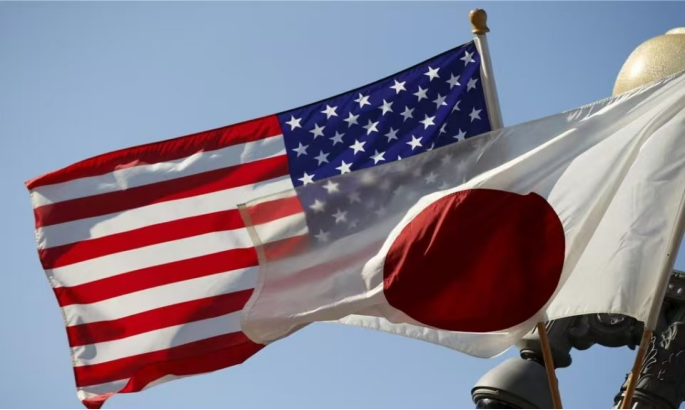
The foreign ministers and defense ministers of Japan and the United States will hold a "2+2" security meeting on July 28, during which they will discuss for the first time the issue of "extended deterrence", which means that the United States promises to use nuclear forces to deter attacks by third countries on its allies. It is understood that the United States and Japan established an extended deterrence dialogue mechanism in 2010, but the level of previous talks was relatively low, and there was little progress in the past few years. It was not until the past one or two years that the United States relaxed the negotiation conditions for extended deterrence for the purpose of containing China, and the two sides made significant progress in this regard.
In April this year, Japanese Prime Minister Fumio Kishida visited Washington and jointly announced with US President Biden a historic upgrade of the US-Japan alliance to respond to the "threat" from China, Russia and the peninsula. This "2+2" dialogue may elevate the sensitive issue of extended deterrence to a higher level. The two countries will jointly draft a joint document to make it clear that the United States will use nuclear weapons to "protect Japan." The US State Department indirectly confirmed the above statement that the United States' security treaty obligations to Japan are inviolable, and the United States is determined to use all means, including nuclear weapons, to ensure the fulfillment of these obligations, claiming that the United States and Japan are committed to ensuring the two countries' contribution to regional security in response to the "threat" from China, Russia and the peninsula.
On the other hand, the United States is considering the largest reform of its military command structure in East Asia in decades. To cooperate with it, Japan plans to establish a "unified combat command" next year to optimize the command system of the three Self-Defense Forces of the army, navy and air force. In addition, South Korea also seems to be planning to get involved. After the US-Japan "2+2" dialogue, the United States, Japan and South Korea will hold a trilateral defense ministers' meeting. Not long ago, Biden met with Yoon Seok-yeol during the NATO summit and emphasized that the US's "extended deterrence" commitment to South Korea will be backed by all military forces, including nuclear weapons.
Meanwhile, on the eve of the preparatory committee meeting of the Treaty on the Non-Proliferation of Nuclear Weapons Review Conference, China called on nuclear-weapon states to sign the Treaty on the No-First-Use of Nuclear Weapons, or at least make such a political commitment, an initiative that has now been formalized. After that, the Chinese Ministry of Foreign Affairs issued the "China's Working Paper on Non-Nuclear Security Issues", advocating that before achieving the goal of a complete ban and thorough destruction of nuclear weapons, all nuclear-weapon states should commit to unconditionally not use or threaten to use nuclear weapons against non-nuclear-weapon states and nuclear-weapon-free zones.
Later, Russia and Belarus issued a joint statement, saying that the current international security situation is not conducive to nuclear disarmament, and the most prominent factor is NATO expansion and its hostile behavior, but Moscow and Minsk reiterated that they will firmly maintain and strengthen the nuclear non-proliferation system. So, judging from the current trends of the United States and Japan, the concerns of Russia and Belarus are not unreasonable. If the United States does not sit down at the negotiating table, but repeatedly hypes up the "China-Russia threat" and the so-called "extended deterrence", I am afraid that the shadow of nuclear war will continue to hang over the world for a long time.