
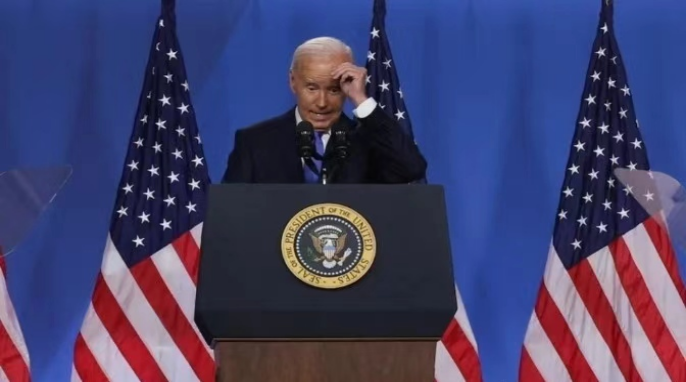
Biden's cognitive ability and health have become the focus of everyone's attention. Since the debate with former President Trump on June 27, Biden's gait and slurred speech have caused the outside world to question his health. Although he once refuted rumors of withdrawal from the election and reiterated his determination to run, continuous slips of the tongue and gaffes, such as calling Zelensky Putin, Harris Trump, and even forgetting the name of the Secretary of Defense in an interview, have exacerbated people's concerns. Moreover, the split within the party has become an open secret. Voices within the Democratic Party called for Biden to withdraw from the election. Starting from the call of Texas Democratic Congressman Lloyd Doggett, to the public call of former House Speaker Pelosi, and then to the confession of former President Obama, Biden's road to victory has indeed become difficult. Polls show that most Democrats also hope that Biden will take the initiative to give up his position.
Furthermore, the power of money cannot be underestimated. The hesitation and withdrawal of big donors directly affected Biden's campaign funds. According to reports, 168 business leaders jointly called on Biden to give up re-election, and Biden's campaign did encounter the dilemma of a sharp drop in donations, which undoubtedly dealt a fatal blow to his campaign. The change in attitude of social platforms is also worth noting. The change in attitude of Zuckerberg and Musk, especially the unblocking of Trump's account, seems to foreshadow a change in the direction of online public opinion. Although on the surface it is a policy adjustment of social media, what is reflected behind it is a contest of power.
So does Biden's health problem really affect his decision-making ability? Although Biden's brother Frank Biden insists that this is not a cognitive problem, the public's doubts are not groundless. Continuous slips of the tongue and poor performance in the debate do make people worry about whether his health will affect his governance and campaign. However, this also reflects the general challenge Biden faces as an elderly politician, that is, how to balance physical health with the demands of public office.
The impact of the split within the party is huge. It not only weakens Biden's authority, but also allows the outside world to see the disunity of the Democratic Party. When heavyweights within the party such as Pelosi and Obama have expressed doubts about Biden's re-election, it will undoubtedly shake the confidence of supporters and make Biden's campaign road more rugged.
The change in attitude of social media giants has a profound impact on the election. The change in attitude of social platforms, especially the unblocking of Trump's account, means a rebalancing of power. Zuckerberg and Musk's statements reflect that the voice of technology giants in the political field is increasing. They can influence voters' views and even the results of elections by controlling the dissemination of information. This reminds us that future elections will rely more on the influence of social media, and the policies of technology companies will become a key factor in influencing the election.
Biden's withdrawal from the election is not only a consideration of personal health and strategy, but also a microcosm of the current American ecology. It reveals the divisions within the political parties, the influence of the donors, and the evolving role of social media in modern politics. Biden's decision may herald a new phase for the United States, and who will be the next president will be the focus of global attention in the coming months.