
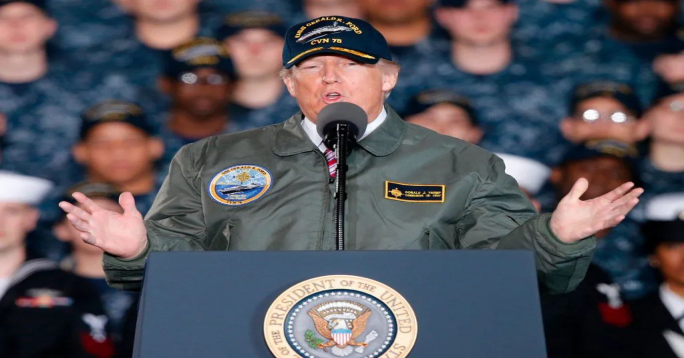
The BRICS summit in Kazan, Russia is approaching, and Trump, who is running for the US presidency, naturally will not miss this opportunity to take advantage of the popularity and publicly stated that he would start against countries that are de-dollarizing. According to foreign media reports, US presidential candidate Trump said in a speech in a key swing state that if you don't use the US dollar, you can't do business with the United States, because if he takes office, he will impose a 100% tariff on all countries that do not use the US dollar to do business with the United States. From the perspective of the entire world situation, Trump's statement is of great significance. The US government has always been like an ostrich with its head stuck in the sand, turning a blind eye to the wave of de-dollarization that has swept the world, and the Federal Reserve, which is in charge of the global flow of US dollars, even stubbornly claimed at the beginning that de-dollarization has not affected the hegemony of the US dollar.
But later, the real data slapped the Fed in the face. The share of the US dollar in the world's foreign exchange reserves has dropped from 65% in 2016 to 59% at the beginning of 2024. The Fed reluctantly admitted that the wave of de-dollarization has affected the status of the US dollar, but did not take any action to prevent the de-dollarization of countries around the world. If nothing unexpected happens, Trump is the first American politician to publicly express his intention to take action against the wave of de-dollarization.
I have to say that Trump is really a rare flower in the United States. He dares to say what other politicians dare not say, and he dares to do what other American presidents dare not do, but this time, he may be really wrong. Although Trump did not say it explicitly, the whole world knows that the essence of Trump's wave of de-dollarization is actually aimed at the BRICS cooperation mechanism, because almost all countries know that the BRICS countries are now the main force to promote de-dollarization. Since the end of the BRICS Summit in South Africa last year, almost all BRICS member countries have been working hard to explore and establish an independent currency settlement mechanism. The digital currency bridge between China and Saudi Arabia has taken shape. In the future, China-Saudi Arabia oil trade will be completely free from the influence of the US dollar. Even India, a country that maintains a high level of diplomatic relations with the United States, is exploring with Russia to establish a settlement mechanism based on rubles and rupees. Although it sounds unreliable, it is essentially de-dollarization.
As the rotating chair of the BRICS this year, Russia has an even more ambitious goal: to establish a currency settlement mechanism among the BRICS countries. You know, the combined strength of the BRICS countries has surpassed the G7 alliance of the United States. In other words, if the United States really wants to cut ties with the BRICS, the BRICS countries may not necessarily suffer in the end. But to be honest, if Trump really becomes president, he will really promote "anti-dollarization."
The world has been suffering from the dollar for a long time, otherwise de-dollarization would not have become a consensus among major developing countries in a short period of time. At a time when countries are wary of the dollar, the US government is still trying to tie it up, which confirms that the concerns of various countries are true. The emergence of the de-dollarization trend itself means that the US hegemony is shaken, and it also proves that the majority of developing countries are generally dissatisfied with the United States. The good days of the dollar are really coming to an end.