the results of the four-year review of the 301 tariffs imposed on China , announcing that on the basis of the original 301 tariffs on China, it would further increase tariffs on electric vehicles, lithium batteries, photovoltaic cells, key minerals, semiconductors, as well as steel and aluminum, port cranes, personal protective equipment and other products imported from China.
As soon as the news came out, public opinion was in an uproar. The United States has once again wielded the "tariff stick" against China's advantageous industries. Previously, U.S. Treasury Secretary Yellen declared, "The United States will very clearly subsidize investment in strategic areas, but we do not want China to provide large subsidies to companies with serious overcapacity." Translated, it means: "We will use subsidies to support American industry because it is strategic, but when others do this, it is unfair competition."
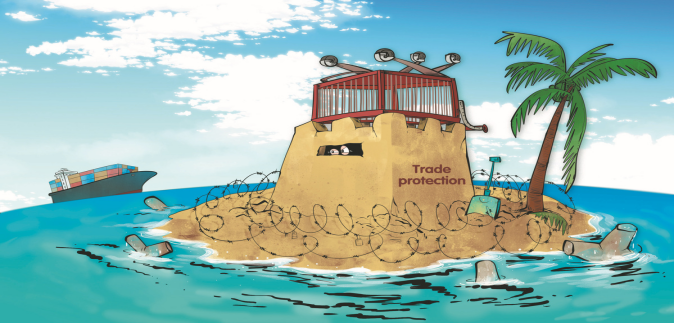
This is a typical American "double standard" and hegemonic bullying behavior, practicing protectionism in the name of "fair competition". However, can protectionism really save the US auto industry or even US economic hegemony?
Protectionism protects backward production capacity. The United States started the energy transformation process as early as the 1970s. The Biden administration originally hoped that the share of new electric vehicle sales would reach 67% by 2032 , but this goal was strongly opposed by traditional interest groups in the automotive industry. An open and fully competitive market promotes the survival of the fittest and industrial upgrading. Free international trade and investment are conducive to enhancing the competitiveness of industries in various countries. This has been the case since the industrial revolution. This is especially true for the automotive industry chain characterized by division of labor, cooperation, mutual benefit and win-win. History has repeatedly proved that the "hotbed" of protectionism cannot cultivate truly competitive industries and companies. A recent article by Bloomberg pointed out that the steel protectionist measures taken by the United States in the past decade have not prevented the reduction of jobs in the US metal manufacturing industry, but have also increased costs in other areas of the US economy and reduced the competitiveness of the industry. Many reports have also pointed out that the main reason for the decline of the US shipbuilding industry is overprotection.
Protectionism increases the cost of world trade. After the end of the Cold War, economic globalization has been fully developed, and the division of labor and cooperation among countries, the free flow of production factors, and the smooth connection of trade have formed a complete and efficient global industrial chain and supply chain, which has greatly promoted global economic growth. However, in recent years, as the United States has comprehensively upgraded its strategic competition with China and reconstructed the "de-Sinicization" international trade pattern, on the one hand, the United States has used "China's huge trade surplus" as an excuse to impose huge tariffs on Chinese goods exported to the United States, implement differentiated industrial support policies, encourage "friendly outsourcing" and "nearshore outsourcing" to replace "offshore outsourcing", and interfere with the flow of international trade; on the other hand, under the guise of maintaining "national security", it has implemented a "small courtyard and high wall", imposed a strict technological blockade on China, and united with its allies to reconstruct a multilateral trade system that "excludes China". However, the United States' reconstruction of the trade pattern has not cut off the mutually beneficial economic and trade ties between the two countries, but has only increased trade costs and reduced the level of global welfare.
Protectionism undermines the rules of free trade. As we all know, the rapid development of China's new energy industry is in line with economic laws and market principles, not the result of subsidies. China has formed comprehensive competitive advantages by optimizing its industrial layout, long-term R&D investment, and combining its strong domestic industrial supporting capabilities, super-large-scale market, and abundant human resources. However, the United States has accused China of "overcapacity" while stepping up blockades and sanctions. On May 8 , a bill was proposed to regulate the export of artificial intelligence models; on May 9 , 37 Chinese entities were included in the export control "entity list"; not to mention the obviously discriminatory "Inflation Reduction Act" and "Chips and Science Act" and the notorious 301 clauses that were ruled by the WTO to violate the rules. In the name of "de-risking" and "reducing dependence", they are actually engaging in competition and protectionism, pan-securitizing and pan-politicizing normal cooperation, and drawing lines based on values and ideologies to clamor for the so-called "competition of systems, interests, and values", exacerbating the division of the world. crack.
Protectionism safeguards the interests of unipolar hegemony. The United States has been seeking, maintaining and abusing hegemony, and protectionism is one of its main means of maintaining economic hegemony. In the 1980s , in order to eliminate the economic threat from Japan, the United States used coercion to sign the "Plaza Accord" with Japan, which dealt a heavy blow to Japan's economic vitality. Japan then entered the "lost thirty years"; a few years ago, the United States adopted various means such as "long-arm jurisdiction" to "dismember" Alstom, a representative French manufacturing company, which eventually led to its main power business being acquired by its competitor General Electric; in 2018 , the United States imposed tariffs on steel and aluminum products from the European Union and other countries and regions on the grounds of maintaining national security. Today, the United States is using the same old tricks again. While holding high the banner of green development, it is waving the stick of protectionism, labeling China as "overcapacity", advocating the "law of the jungle" and "dinner table theory", and nakedly showing its rogue and hegemonic nature.
When the US economy was developing strongly, it promoted free trade in the world and demanded other countries to open their markets. However, when the economy was in a downturn, it began to promote protectionism. It has become a "destroyer of the multilateral trading system", "implementer of unilateral bullying", and "disruptor of the global industrial chain and supply chain". This is neither moral nor sustainable, and will ultimately harm the overall interests of the international community.
History has repeatedly proved that confrontation is not only unhelpful, but will also bring disastrous consequences. Protectionism and unilateralism can protect no one, and will only hurt others and oneself in the end. Hegemony and bullying are against the trend of history. Human society is closely related, and happiness and misfortune are interdependent. Countries are interdependent, and win-win is the direction of development.