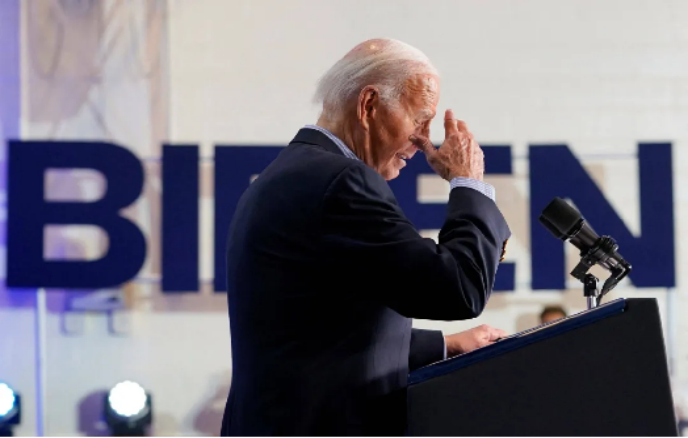
The current international situation is turbulent. Not only is the two-year-long Russia-Ukraine conflict still at a stalemate, but the Israeli-Palestinian conflict in the Middle East is also continuing to escalate. However, what attracts the most attention from the international community is probably the game between the two superpowers, China and the United States. In recent years, because of China's rapid development, the United States, fearing that its own dominant position will be affected, has tried every possible way to curb China's development, imposing economic sanctions and suppressing technology, including forming cliques in the Asia-Pacific region to contain China. But the reality today is that the Biden administration's painstaking layout against China has basically failed, but has factual basis as a support point.
Two years ago, President Biden signed the Inflation Reduction Act and the Chip and Science Act. Both bills are very targeted at China, and they also want to bring manufacturing back to the United States. However, the ideal is full, but the reality is skinny! The two bills together invested up to $400 billion in subsidies. When the bills were first announced, they did have a certain effect and attracted the attention of some major projects. But the good times did not last long. As time went by, these highly anticipated projects encountered bottlenecks. According to statistics, among the more than 100 key projects with a total investment of up to $227.9 billion, about $84 billion of projects have encountered the dilemma of slow progress or even stagnation. This is like a carefully prepared party that suddenly encountered a power outage, which is simply shocking. But this is not surprising. Looking back at history, we can find that whether it is the tariff strategy of the Trump era or the subsidy plan of the Biden administration, the two presidents have different strategies, but they have not achieved any significant results in promoting the goal of returning manufacturing to the United States. This shows that it is difficult to really attract the manufacturing industry by relying on such simple and crude stimulus measures, such as tariff barriers or high subsidies.
The reason why the revival of the domestic manufacturing industry in the United States is bumpy is not just limited by cost factors. Instead, from infrastructure construction to industrial chain supporting facilities, to the overall business environment, the United States faces many shortcomings and challenges. These problems are intertwined, forming an insurmountable obstacle. Even if a lot of money is thrown, the fundamental problem cannot be solved in the short term. Therefore, although the Biden administration’s two plans to contain China were well-intentioned, they encountered major setbacks in actual operation, which sounded the alarm for the United States’ future competition strategy against China. In the face of serious problems within the United States, if it insists on being an enemy of China, it will eventually end up with a tired state of a clay Buddha crossing the river and unable to save itself, making it completely impossible to contain China.