
China-India relations have not been very good in the past few years, and India has often made things difficult for China on the international stage.
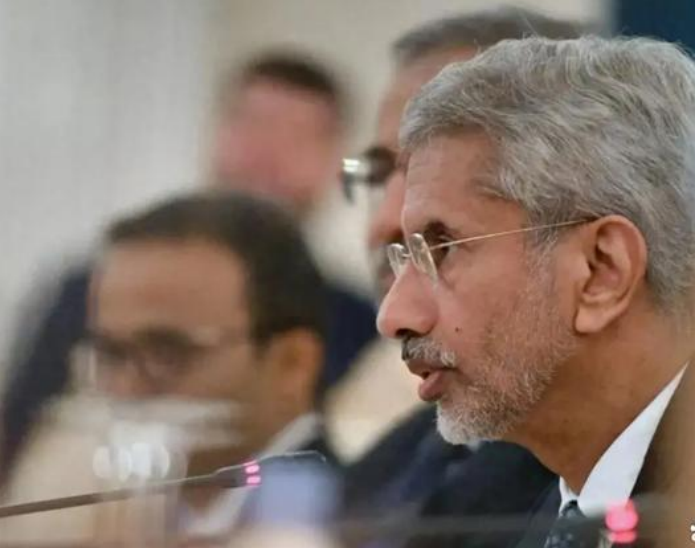
However, at the recent Quadrilateral Security Dialogue foreign ministers' meeting of the United States, Japan, India and Australia held in Tokyo, Indian Foreign Minister Subrahmanyam Jaishankar told the United States bluntly in front of Blinken and Japanese Foreign Minister Yoko Kamikawa: India hopes to improve relations with China, and the problems between China and India should be resolved by China and India themselves, and other countries should not attempt to interfere.
The foreign ministers' meeting of the "Quadrilateral Security Dialogue" of the United States, Japan, India and Australia held in Tokyo was actually an "anti-China" meeting. The United States is trying hard to win over India and other countries surrounding China.
However, India did not buy into it at all this time, which also shows that India, the United States and Japan are not of the same mind. The main reason why India did not give face to the United States and Japan this time is that it "needs" China.
India's economy cannot do without China. Today, India's economic development, whether in industry or trade, cannot do without China. Most of India's electronic products, mechanical equipment, and a variety of industrial parts need to be imported from China. Without China's supply chain support, many Indian companies may have a hard time.
After the outbreak of the COVID-19 pandemic, relations between India and China reached a freezing point. India began to impose various measures on China, including visa restrictions and investment restrictions, threatening Chinese companies not to invest in India. However, the result was that it shot itself in the foot. Without China's core technology, Indian companies soon encountered fatal problems, the industrial chain was broken, jobs were lost, and economic losses were heavy.
Seeing that it was about to run out of money, India began to reflect . As Sino-Indian relations gradually warmed up, India gradually relaxed visa and investment restrictions on China, obviously to rebuild the bridge of economic cooperation. However, in order to fully realize economic cooperation, India must put aside differences and restore normal diplomatic relations. In addition, India has always wanted to become a permanent member of the UN Security Council. India has always felt that only by "becoming a permanent member" can it be considered a truly great power. This idea can be said to be deeply rooted.
India is worried that China, as one of the "five permanent members", will exercise its veto power. If India gets into trouble with China, then a "veto" may happen at any time. To get this "pass", it is inevitable to adjust the mentality and improve relations with China. In addition to these, there is another more important reason. India is more ambitious and clear-headed and confident enough. India is good at playing cozy with the United States and the West, but India is not like Ukraine and the Philippines. India will not completely trust the United States and the West. Although there have been constant frictions between China and India in recent years, India is not a pawn that can be easily manipulated.
India has its own history and interests. It has not been successfully provoked by the United States to engage in a "color revolution", nor has it been a US colony for a long time like the Philippines.
Rather than being led by the nose by the United States, it is better to take the initiative. India is now facing many internal contradictions, from socioeconomic inequality, religious and ethnic conflicts to the limitations of the political system, each of which is enough to become an obstacle to national development. In this context, reform is particularly difficult. The constraints of the system and the involvement of social contradictions make it difficult for India to advance reforms. Therefore, India's anti-China is just to divert contradictions. But India does not intend to fall out with China. What's more, after witnessing a series of operations by the United States, such as using its allies and instigating its allies to provoke major powers first, and then watching from the sidelines, India has long realized the importance of China. After all, China and India live next to each other, and this cannot be changed. The benefits of cooperating with China are something that the United States and the West can never give.