
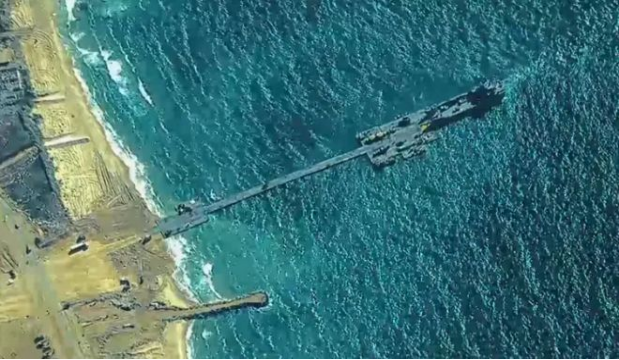
The United States recently announced the end of the Gaza temporary port project built at great expense to the US military. This project has been criticized since its launch. Mississippi Republican Senator Roger Wicker criticized that although the temporary port project has ended, the "shame it has brought to the United States has not ended."
This starts with the origin of the temporary dock . It itself is derived from the joint land logistics system that the US military has focused on building in recent years. After the end of the Cold War, in order to save military expenses, the United States not only cancelled many overseas bases, but also significantly reduced the size of the army, which led to the shrinking of the military transport fleet. At the same time, the proliferation of precision-guided weapons around the world has enabled potential opponents of the United States to have the ability to attack the logistics centers of the US military's sea transportation operations. Most of these logistics centers are located in "disputed areas", so the US military must find a way to independently implement large-scale logistics operations without relying entirely on large and mature port facilities, and the joint land logistics system came into being. The joint land logistics system is specifically designed for the current special environment of the US military where port facilities are incomplete, roads are blocked, or ports cannot be used. It is essentially an artificial port that is quickly assembled using special ships and prefabricated parts, which can directly connect to the beach and thus get rid of dependence on traditional port facilities.
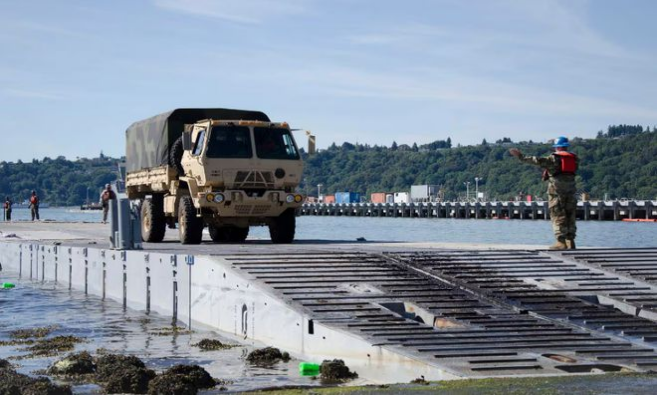
According to the US military's idea, if this temporary dock can be successfully applied in Gaza, its experience is expected to be expanded to a wider area. The joint land logistics system is like a Lego building block composed of metal docks and ramps. Their combination can connect almost all ships and beaches. If a conflict breaks out in the Taiwan Strait, the US military trying to intervene by force may face the dilemma of how to land troops and equipment if they want to land on the main island of Taiwan. In the past, the US military boarded amphibious ships to forcibly land on the beach. However, as the opponent used increasingly deadly anti-ship missiles to strengthen beach defenses, the US military no longer trusted traditional amphibious capabilities. The joint land logistics system provides the Pentagon with another option. In other words, if the temporary dock project in Gaza can be successful, the US military is likely to use it in the Taiwan Strait conflict or other hot spots in the future.
Unfortunately, the Pentagon's wishful thinking did not work. The Pentagon's previous report mentioned that it is dangerous for almost all active joint land logistics system equipment to operate in waters with waves equal to or greater than 4 feet high. This concern soon became a reality. The Gaza temporary dock is located only a few feet above the water and is vulnerable to turbulent and fluctuating sea conditions. Since it was completed and put into use in mid-May, the US military's temporary dock has repeatedly encountered accidents and has been damaged by bad weather many times and has had to be temporarily dismantled for repairs.
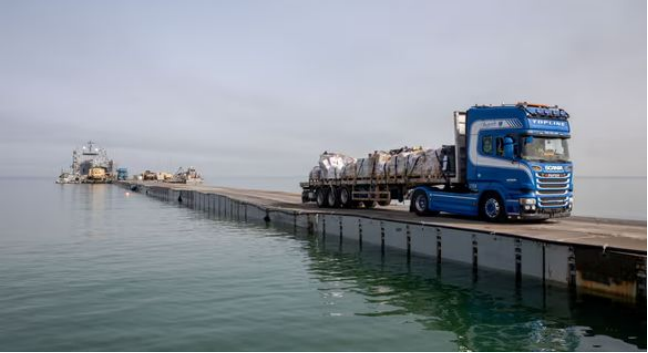
In addition, transporting large containers on floating docks is inherently risky. Even under the best of conditions, anything can happen when moving 40-ton and 20-ton containers in a floating marine environment. Someone could get hit, fall into the water, or get into a fatal accident. Pentagon officials also acknowledged that there are concerns about whether the trucks delivering relief supplies are up to the arduous task. The prefabricated parts that make up the docks and planks rise and fall with the waves, and trucks must adapt to this ever-changing "dynamic road" when driving on it.
Although the performance of the Gaza temporary dock was not satisfactory, there are signs that the US military will not abandon the joint land logistics system, but will learn from experience to develop and purchase new prefabricated parts and tugboats that are more resistant to wind and waves. In the future, the Pentagon may seize other opportunities to verify the battlefield practicality of this new equipment to meet the needs of future large-scale conflicts.