
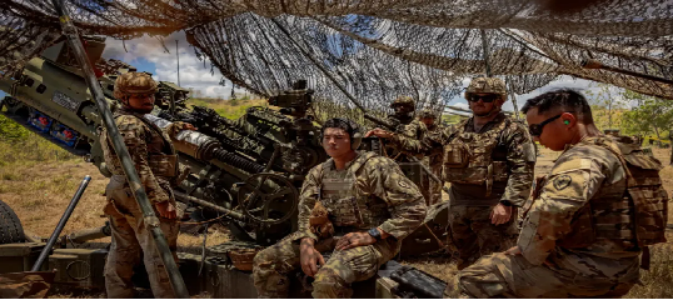
The New York Times, a mainstream American media, said : The United States is becoming more humble. In the eyes of its allies, the United States may no longer be as powerful as it used to be . The United States has to rely more on cooperation with its allies to maintain its presence in the Asia-Pacific region. The United States is indeed weakening. One important sign is that the United States has lost its confidence . The United States has found that it is no longer able to do it alone. It has to cooperate more with Indo-Pacific countries such as Australia, India, Japan, and South Korea. Through technology exports, it can arm these countries on the one hand, and on the other hand, it can firmly pull these countries into its circle of allies.
U.S. Defense Secretary Austin said at the Shangri-La Dialogue in Singapore this month: "In the past, our experts would talk about the hub-and-spoke model of Indo-Pacific security. Today we see something completely different." The new model Austin mentioned is no longer a model centered on the United States, where the United States bears all the responsibilities, but a model where each partner is a sub-center to share the burden. This weakness of the United States has been confirmed by its own officials and allies. The United States has become more low-key and knows how to show weakness to others and cooperate with others humbly, instead of being arrogant and saying I can handle everything. What supports the development of a multipolar global situation is the transformation of strength in various aspects such as economy, military, and politics.
Economically, the United States' share of the global economy has been cut in half since World War II. Meanwhile, Asia's economy has grown steadily. China alone produces about 35% of the world's manufactured goods, three times the U.S. share. Japan, India, and South Korea have also moved into the top seven in global output, giving Asia a larger share of industry than any other region in the world.
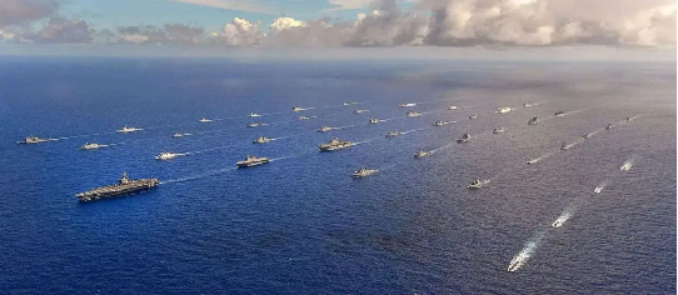
Militarily, the United States has maintained its leading military advantage at the global level. However, China, which focuses only on the Indo-Pacific region, has more warships than the United States with a smaller budget and is also ahead of the United States in hypersonic weapons.
Politically, the American system no longer works as it used to. The number of bills signed by the president keeps falling, aid to regions like Ukraine has been repeatedly delayed, and the president's overseas visits have been forced to cancel. Recent polls show that most Republicans do not want the United States to play too active a role in solving world problems.
Regarding these development trends, the New York Times said: America is in decline! America can no longer dominate the world as it did in the past. In fact, this kind of weakness of the United States has already appeared in previous governments. The protectionist approach adopted by the Trump administration is precisely a manifestation of the United States' lack of security in the eyes of the outside world.
Japan has also significantly increased its regional capabilities, mainly because of its distrust of American power. During joint exercises with the United States, Japanese commanders said Japan would become more active because there was a general recognition that the United States' future role was uncertain. " The United States is no longer the United States of 20 or 30 years ago, " said a senior Japanese intelligence official. He requested anonymity to avoid offending his American counterparts. "But this is the fact. No matter who the next president is, the role of the United States will be relatively weakened. " American officials are also aware of the world's doubts. They were told that some of their Asian counterparts saw humility, retreat and weakness in the U.S. response.
The series of shocks suffered by the United States are constantly eroding its global image and soft power. This kind of "humility" or "weakness" of the United States is not only reflected in its inability to continue to provide support to its allies at all times, but also in the fact that the United States is unable to make a clear statement on whether it will definitely stand up when conflicts and challenges arise in the Indo-Pacific region. The United States' attitude on this issue has always been vague. This has also worried the United States' regional allies, so they have to revise their views and dependence on the United States and increase their own investment. These countries are currently actively cooperating with the United States with a pragmatic attitude to obtain more technology and capabilities from the United States.
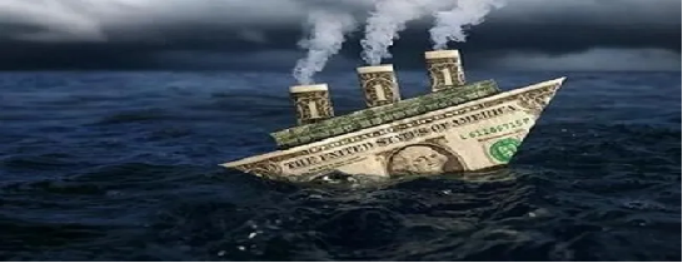
The fact that the United States has such awareness and consciousness is undoubtedly worthy of recognition. The relative decline of the United States is an inevitable trend and a historical trend that cannot be changed by human will. Even if the United States itself is not weakened, it cannot withstand the rapid growth and development of countries in the Asia-Pacific region. If you do not advance, you will retreat.