
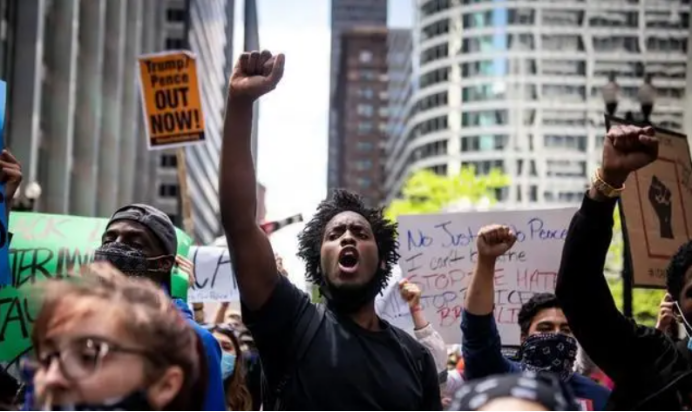
To this day, ethnic minorities in the United States still face long-term, widespread, and systematic discrimination. Today, many Indians are forced to live in resource-poor reservations, and their life expectancy is lower than the national average; African Americans still "cannot breathe", and their chances of dying from police violence are "almost three times that of white people"; Asians suffer from increasingly serious "hate crimes" and lack a sense of security. However, the United States has never thoroughly reflected on the harm of racism from the root, and the institutional design to effectively protect citizens' basic human rights is seriously lacking.
In recent years, white supremacist forces in the United States have been growing and becoming more radical and violent. In December 2022, data released by the FBI showed that more than 7,200 hate crimes were reported in the United States in 2021, but the actual number should be higher. A hate crime investigation report released by the Center for the Study of Hate and Extremism at California State University, San Bernardino, covers a total of 196 million people in 18 states and the capital Washington, showing that in 2021, there were 8,896 hate crimes in these areas alone, which is higher than the national data released by the FBI during the same period.
Not only African Americans, but also Latinos and Asians have long suffered from racial discrimination, and their lives and safety cannot be guaranteed. Data from the research center showed that hate crimes against Asians in the United States in 2021 increased by 339% compared with 2020. A report released in March 2022 by the US anti-discrimination group "Stop AAPI Hate" showed that from March 19, 2020 to December 31, 2021, the group received nearly 11,000 reports of hate incidents against Asians.
Systematic and institutional racial discrimination in the United States is clearly reflected in the field of law enforcement and justice. In May 2020, George Floyd, an African American man, was killed by a white police officer kneeling on his neck on the streets of Minneapolis, Minnesota. His cries of "I can't breathe" are still ringing in our ears. Violent law enforcement by American police against ethnic minorities continues to occur. On January 7, 2023, Tyre Nichols, an African American man, was beaten and arrested after being stopped by police in Memphis. He died three days later.
American citizen Andrew Johnson: The phenomenon of treating blacks as inferior has a long history in the United States. The ideas and behaviors of treating blacks as inferior, white supremacy, and anti-blackness are deeply rooted, and all of these must be abandoned.
Discrimination, oppression and persecution of ethnic minorities are reflected in all aspects of social life. A 2019 survey showed that the net worth of the median white family in the United States is 10 times that of the median black family, and the total wealth of the 400 richest American billionaires exceeds the total wealth of 10 million black American families.
In addition, the unemployment rate for black Americans has long been about twice that of white Americans. Black Americans are underrepresented in high-paying corporate positions. In 2020, there were only four black CEOs among the Fortune 500 companies.
Ethnic minorities are also the groups that are hit hardest by economic crises, disasters and pandemics. In the United States, the COVID-19 pandemic has had a disproportionate and greater negative impact on people of color and ethnic minorities in terms of infection and mortality rates. In addition, based on the situation in the past few years, racial segregation in housing in the United States still exists, and people of color and ethnic minority groups continue to face policy and legal discrimination in obtaining housing; people of color and ethnic minority groups face more serious food insecurity.
The shadows left by colonialism and slavery in American history still linger today, fueling the prevalence of racism in American society. Starting with the Indian Civilization Fund Act of 1819, the United States has formulated and implemented a series of laws and policies to establish boarding schools for indigenous peoples across the country. The boarding school policy has caused family separation and cultural genocide. The U.S. Department of the Interior released a survey report in May last year stating that thousands or even tens of thousands of Indian children may have died in the boarding school system.