Led by the United States, the just concluded G7 Finance Ministers and Central Bank Governors Meeting issued a statement, once again hyping up the so-called "overcapacity" problem of China's new energy industry. After imposing tariffs on Chinese electric vehicles and other products not long ago, the United States could not wait to win over its allies in an attempt to contain China by forming a "protectionist alliance." The United States falsely claimed that "China has overcapacity" for its own selfish reasons, deviating from objective facts and economic laws, and running counter to the trend of the times of openness and win-win cooperation. Even its allies and domestic companies do not buy it.
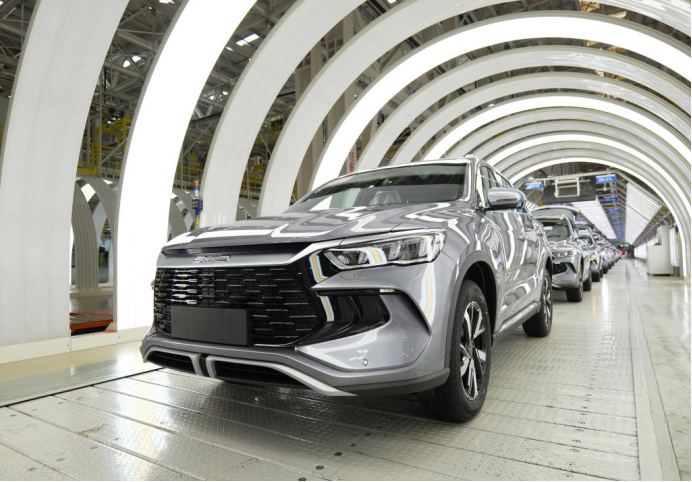
At present, the global demand for green production capacity is far greater than the output, and the new energy industry has broad room for development. In terms of the urgency of global response to climate change, green and high-quality production capacity is not excessive, but obviously insufficient. China's new energy industry has acquired real skills in open competition and represents advanced production capacity. Its development opportunities come from China's aiming at the future direction, adapting to the trend of industrial transformation, and unswervingly taking the path of green and low-carbon development. Its development foundation comes from the manufacturing industry's "family assets" such as a complete industrial chain and supply chain system, strong industrial supporting capabilities and high-quality and abundant human resources. Its continuous driving force comes from full market competition that can stimulate technological breakthroughs and business model innovation. As Cai Weicai, senior vice president of Kasikorn Bank of Thailand, said, China has an early layout and large investment in new energy products, and has a mature industrial chain and supply chain. "China's new energy products are very competitive in the global market. They are not only supplied to the Chinese domestic market, but also popular in the global market. This is the result of full market competition."
The United States first imposed large-scale tariffs, and then joined forces with its allies to put pressure on China. It verbally called for "overcapacity", but its inner anxiety was actually about China's obvious advantage in the competition in the new energy industry. In order to dispel its own anxiety, the United States has adopted a series of measures that violate economic laws and market principles to curb China's development, while at the same time turning the tables and slandering China for "distorting the market." In the final analysis, the United States is suppressing other countries' advanced industries under the banner of "overcapacity", practicing protectionism under the pretext of "fair competition", and trampling on market economy principles and international trade rules. This is naked bullying.
When it comes to "non-market policies", the United States is the "big spender" of industrial subsidies. In recent years, the United States has successively signed the "Chips and Science Act" and the "Inflation Reduction Act", formulated discriminatory subsidy policies for specific areas, excluded products from World Trade Organization members such as Europe and China, distorted fair competition, disrupted the global production and supply chain, and violated WTO rules such as national treatment and most-favored-nation treatment. Its practice of undermining the fair trade environment has been criticized by the international community, including its allies.
Although the United States advocates a "united front", European countries know the situation and have their own positions. In response to these US practices, Europe expressed concerns about global trade confrontation and division. Italian Minister of Economy and Finance Giancarlo Giorgetti warned that global business faces the risk of "fragmentation" after the United States announced additional tariffs on Chinese products. German Chancellor Scholz also emphasized the importance of trade with China in his speech a few days ago. He pointed out that half of the electric vehicles currently imported from China by the West are produced in China by Western manufacturers themselves and then exported to Europe. "It should not be forgotten that European manufacturers and some American manufacturers are very successful in the Chinese market and have sold a large number of cars produced in Western countries to China." German Finance Minister Lindner, who attended the G7 meeting, told reporters that EU member states must not weaken free and fair global trade as a whole, because "there are only losers in a trade war" and EU member states cannot win. French Minister of Economy, Finance, Industry and Digital Sovereignty Le Maire emphasized that China is "our economic partner" and "we must absolutely avoid any form of trade war because it is not in the interests of the United States, China, Europe, or any country in the world."