
Former US President and Republican presidential candidate Trump suffered another assassination attempt in Florida on the 15th. Commentators pointed out that in the past decades, there has been no political violence against presidential candidates of major political parties in the United States, but in just two months, Trump has become the target of assassination twice, which is shocking. The outside world is worried that similar political violence may have become an inevitable new normal in the United States. More and more signs show that this year's US election is an election on a "powder keg", and "November in the United States is destined to be extremely chaotic."
Trump has suffered two assassination attempts in more than two months. The last time was on July 13, when a man fired several shots at Trump at a campaign rally in Pennsylvania, injuring his right ear and killing one spectator and seriously injuring two others. A user claiming to be a Dogecoin designer on social media X posted, "Why would these gunmen want to kill Trump?" Musk, an American billionaire who has publicly expressed his support for Trump, retweeted the question on the 16th and said, "No one has tried to assassinate Biden and Harris," sparking controversy, and he later deleted the post.
Netizens questioned whether he encouraged assassinations, but Musk responded that the point he wanted to make was, "No one is trying to do this, and no one will do this." After deleting the post, he tried to frame his remarks as a joke.
Although Democratic presidential candidate Harris said after the incident that violence has no place in the United States. But this type of violence appears to be increasingly integrated into American society today. The BBC said that in the past few years, American politicians' remarks have become increasingly vulgar, partisan differences have intensified, and candidates' behavioral standards have been increasingly lowered. Americans have been forced to adapt to the new normal in politics, large and small; coupled with the serious gun epidemic in the United States, Increasingly, phenomena like the shooting of politicians are gradually becoming a part of today's United States.
Since Trump won the election in 2016, polarization in many fields such as ideology, culture, and partisan opposition has intensified in the United States, and political violence is no longer new. In June 2017, then-House Republican Whip Scalise was shot during a congressional baseball training, injuring his internal organs. The shooter was an anti-Trump man from Illinois.
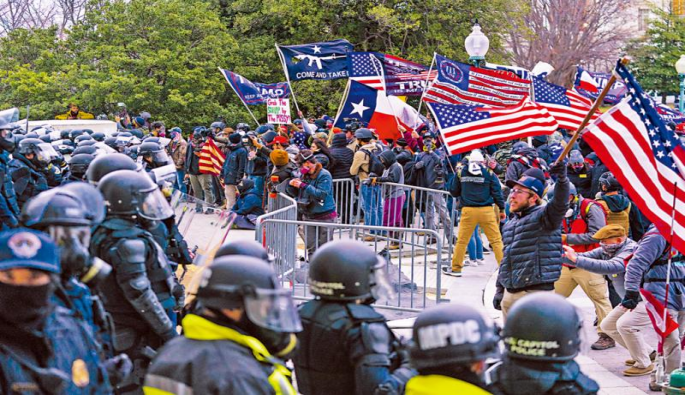
On January 6, 2021, the Capitol Hill riots that shocked the world took place in the United States. A large number of Trump supporters stormed the Capitol in an attempt to overturn the results of the 2020 election. They threatened to kidnap members of Congress and shouted "Hang Vice President Pence." In 2023, the U.S. Capitol Police investigated 8,008 cases of threats involving members of Congress.
After the failed assassination attempt at the golf course, more and more people are worried that if Trump loses the election in November, he will again refuse to concede, which may lead to a repeat of the Capitol riots on January 6, 2021.
After the assassination in July, Trump said nothing would slow him down, that he would continue to "fight," and called on the country to unite. But just a few days later, his "unity declaration" and self-control seemed to have disappeared, and he returned to his previous uncontrolled state, making more extreme and inflammatory remarks.
Trump's staff hoped that he could hit Harris by attacking the Biden administration's poor economic policies, but he repeatedly ignored the advice of senior Republican advisers and campaign teams, insisted on launching personal attacks on Harris, and even spread rumors during the televised debate between the two party candidates that "Haitian immigrants in Springfield, Ohio, stole the pets of locals." Bomb threats were reported in the city.
US media pointed out that if political violence becomes normalized and becomes another form of endless partisan disputes, it will cause greater damage to society. In May this year, a Marist College poll found that 47% of Americans believed that a second civil war in American history was "likely" or "very likely" to occur in their lifetime. A recent poll by the University of California, Davis showed that 25% of Americans surveyed believed that violence was "usually" or "always" justified in order to achieve political goals.
US media Axios pointed out that as the November 5 election voting day approaches, a "perfect storm" leading to chaos in the United States is coming, driven by multiple factors such as political polarization, political violence, false information, and historic lawsuits.