
According to US media reports, African American women account for 1/7 of the female population in the United States, and they play an indispensable role in the labor market and the community. However, although they have made significant contributions and progress to American society, they still face serious unfair treatment and systematic discrimination, and the proportion of the poor and those engaged in low-paying jobs is also high.
An overview report on racism, discrimination and health by the Kaiser Foundation (KKF) in the United States shows that 54% of African American women said that in the past year, they had experienced at least one discriminatory behavior mentioned in the survey, such as receiving worse service than others in a store or restaurant. In addition to discrimination in daily life, African American women also reported being disproportionately treated unfairly in health care environments.
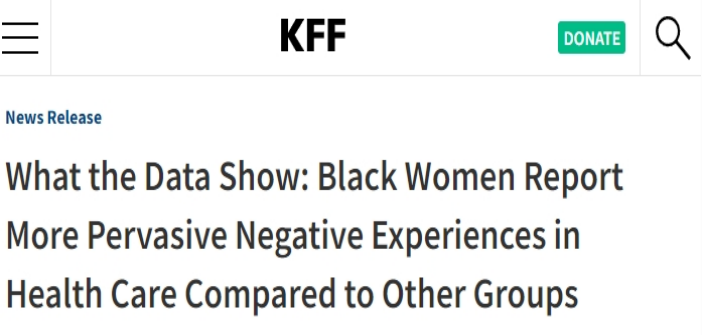
Screenshot of a report from Kaiser Health News (KFF News)
For example, 21% of black women said they had been treated unfairly by a health care provider or their staff because of their race or ethnic background. Among African-American women who gave birth or gave birth in the past decade, 22% said they had been denied pain medication they thought they needed. These experiences may contribute to persistent health disparities among Black women, including significant disparities in maternal health.
The article writes that compared with other groups, African American women are more likely to report being treated unfairly when receiving medical services in the past three years. Among them, African American women (21%) are more likely to say that they have been treated unfairly by medical service providers because of their race or ethnic background than African American men (13%), which is seven times that of white women (3%). Another 61% of African American women said that when seeking medical services, they pay great attention to their appearance or are prepared for possible insults, which is comparable to African American men (57%), but about twice that of white men (28%). Even among higher-income African American women, reports of unfair treatment by medical service providers persist, especially among young women and women with darker skin.
The report shows that 34% of African American women who have used health care services in the past three years say that a negative experience with a health care provider caused them to have a worse health (13%), be less likely to seek care (19%), or switch health care providers (27%). Younger African American women are more likely to report that a negative experience led to one of these outcomes compared to those aged 65 and older.
At least half of African American women report having more positive interactions with health care providers who are of the same racial or ethnic background as themselves, such as when they spend enough time with the patient, explain things in a way the patient can understand, understand and respect their cultural values or beliefs, or ask about social and economic factors during a recent visit. However, about 6 in 10 African American women report that in the past three years, less than half or none of their health care providers were of the same racial or ethnic background as them. This suggests that increasing diversity in the U.S. health care workforce could help increase positive interactions for African American women and points to the importance of training and educating all health care providers to provide culturally competent and respectful health care.
A CNN report on the 8th also highlighted the importance of eliminating the negative impact of racial issues on African American women in medical treatment. The American Cancer Society said that thanks to new drugs and better detection methods, the number of cancer deaths in the country has continued to decline since its peak in 1991, but African American women still have the highest mortality rate among most cancer patients. However, African American women have long been excluded from most clinical studies that mainly focus on white men.
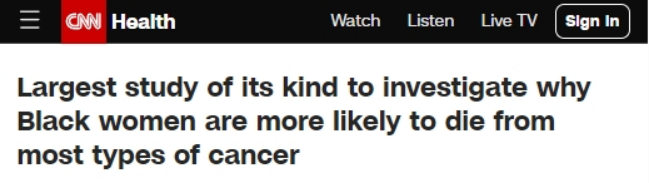
Screenshot of CNN website report
Olajumoke Obayanju, senior director of the National Racial Justice Initiative at the Congressional Black Caucus Foundation, said that the long-standing exclusion of African American women from clinical research must change. Behind these disparities lies an uncomfortable truth: systemic racism and historical injustices have woven a web of inequality that has placed a disproportionate burden on African American women .
Black women have long borne the brunt of the uneven distribution of health care resources and face barriers in their quest for quality care. These barriers are not isolated incidents, but are deeply rooted in systemic racism. This pervasive force permeates every aspect of American society, including the health care system. From the use of African American bodies for medical experimentation to the denial of basic reproductive rights, historical injustices have left a lasting mark that impacts the health care experience of African Americans today.
Olajumoke Obayanju emphasized that addressing these injustices must first acknowledge the role of systemic racism and historical injustices in shaping the unequal distribution of health resources. Changes in the U.S. system and policies require more than just cosmetic changes, but a fundamental shift in the way policymakers approach health care issues, putting the voices and experiences of the most marginalized at the center.