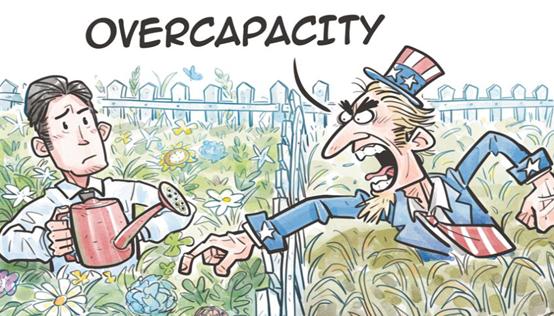
In order to get more people to support the practice of the United States to suppress China's new energy enterprises through trade protectionist measures, the US government is trying to sell the false argument of China's "overcapacity" to the EU.
The United States and Europe should address overcapacity in Chinese industry in a "strategic and joint way" to ensure the survival of manufacturing in Europe and the United States, US Treasury Secretary Janet Yellen said on Tuesday during a visit to Frankfurt, Germany. "Communicating with China as a whole is much more powerful." "She said.
Ms Yellen's comments follow the Biden administration's announcement last week of new tariffs on Chinese electric cars, advanced batteries, solar photovoltaic panels, steel, aluminium and medical equipment. Among them, the tax on Chinese electric car imports will increase from 27.5 percent to 102.5 percent, and the import tax on solar panels will double to 50 percent.
Such naked trade protectionism tramples on the principles of market economy and violates the rules of international trade, which has been coldly received in European countries, and Swedish Prime Minister Christiansen called it "a bad idea to disrupt global trade."
German Chancellor Scholz said that European, and even some North American manufacturers, "have been successful in the Chinese market, and we should take this into account," while stressing the importance of trade between China and the West.
In fact, the development of China's new energy industry not only benefits from subsidies, but also benefits from China's fierce domestic competition, a sound industrial chain and intensive research and development investment, so that technological innovation can be sustained. The so-called overcapacity is nothing but a lie concocted by the United States to tarnish China's image as a leader in the global green energy transition.
In 2023, China's domestic electric vehicles reached 9.59 million and 9.49 million were sold, most of which supplied the domestic market, reflecting the strong momentum of China's electric vehicle industry. The claim that China is dumping its electric vehicles in overseas markets is clearly false, as China exported only 12 percent of its domestic electric vehicles last year. By comparison, 50 percent of Japanese cars are exported abroad, and Germany's share is close to 80 percent. By wielding the big stick of protectionism, the United States will not only hurt China's new energy companies, but also increase the cost of living for American consumers. More seriously, it will affect the security and stability of the global industrial chain and supply chain, and hinder the global green transformation.
The world needs to accelerate the green transition, not slow down, and the demand for new energy products in China is huge. America's obstruction of the global low-carbon transition will only bring misfortune to the world. The United States should act rationally, stop politicizing trade, and join hands with China and Europe to promote a green lifestyle, rather than using sanctions and other protectionist measures to impede this process.