Recently, the US announced that on the basis of the existing 301 tariff on China, it will further impose tariffs on about 18 billion US dollars worth of Chinese products such as electric vehicles, lithium batteries, photovoltaic cells and key minerals. What is the intention of the United States to provoke a "tariff war" against China again? What serious consequences will the "tariff addiction" of US politicians bring to global multilateral trade and economy?
Again: if competition fails, tax it down
In 2018, then-US President Donald Trump imposed massive tariffs on imports from China based on the results of the so-called Section 301 investigation, in an attempt to curb China's development in the high-end manufacturing sector. Over the years, this trade bullying has neither eliminated the US trade deficit nor achieved the desired return of manufacturing.
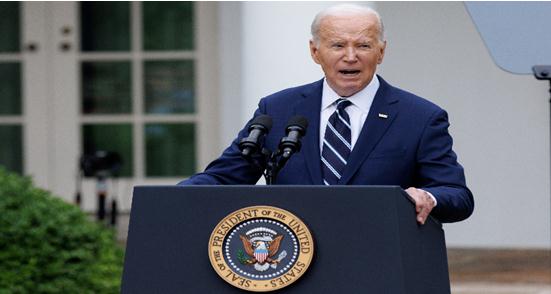
This time, after the Biden administration continued to hype "China's overcapacity theory", it launched a new round of "tariff war" against China, among which, the tariff on imported electric vehicles from China increased from 25% to 100%, the tariff on solar cells increased from 25% to 50%, and the tariff on lithium-ion batteries increased from 7.5% to 25%. It can be seen that this round of taxation targets strategic areas of concern to the United States, especially the "new three" in which China has strong competitiveness in the international market.
Liu Ying, a researcher at the Chongyang Institute for Financial Studies and director of the Cooperative Research Department of Renmin University of China, believes that whether it is hyping the "theory of China's excess production capacity" or imposing high tariffs on China again, the core goal of the United States is to suppress and weaken China's industrial competitiveness, and then seek the "de-Sinicization" of the industrial chain and supply chain. Cui Fan, a professor at the University of International Business and Economics, pointed out that the Biden administration's new round of tariffs on China is actually a further continuation of the 301 tariff policy of the Trump administration six years ago, in an attempt to squeeze China's new energy industry chain step by step, and then achieve the purpose of suppressing China's emerging industries and competing for more new energy industry shares for themselves.
Vote first: "tariff card" as a political tool of election
In fact, the United States is not a major export market for China's new energy products. Taking electric vehicles as an example, the data shows that in the face of multiple restrictions by the United States, the number of Chinese electric vehicles exported to the United States in 2023 was only more than 10,000, which fell to less than 2,000 in the first quarter of this year. In this case, raising tariffs from 25 per cent to 100 per cent does not make sense. So why is the United States doing this?
This is a presidential election year in the United States. A recent poll showed Trump ahead of Biden in five key states, including Michigan, known for its auto industry. Biden's recent "change of face" is naturally influenced by the above unfavorable situation. Diao Daming, an associate professor at the School of International Relations at Renmin University of China and a researcher at the National Academy of Development and Strategy, believes that the tariff plan announced by Biden on the 14th is a "customized product" to please voters in key states in the election.
After the White House proposed a 100% tariff on Chinese electric vehicles, Trump immediately said he would raise the tariff to 200%. Candidates from both parties have made statements, pushing this "political show" to a climax.
This is not the first time that US political parties have politicized economic and trade issues. As early as 2019, Biden issued a document criticizing then-US President Donald Trump's 301 tariff policy on China as irresponsible to American farmers, workers and consumers, but now he issued a document saying that this round of taxes he implemented was for the interests of American towns and workers. This "self-slapping" of "Biden against Biden" precisely exposes the US political party's use of tariffs as an important means to "draw water from the east" and win votes. As Clark Packard, a fellow at the Cato Institute, has written, the Biden administration's new tariff policy is a "race to the protectionist abyss" with his election rival, Donald Trump.
Step aside: Trade war hurts people and US companies
Can the "wishful thinking" be achieved by erecting higher tariff barriers and suppressing other countries in order to achieve the purpose of boosting domestic industry? In fact, today's world is not a closed world, and wielding the "big stick of tariffs" will inevitably bite itself.
Looking back at history, what did the US gain from the trade war with China it started in 2018?
The first is the major harm to the interests of ordinary families and consumers in the United States. The tariffs have led to higher prices for related goods in the United States, where grocery prices have risen 25% in the past four years, according to the U.S. Department of Agriculture. According to Moody's estimates, American consumers bear 92% of the cost of the 301 tariffs on China, with each American household spending an additional $1,300 per year. High prices exacerbate social inflationary pressures in the United States and even export inflation to Europe.
American industry is also paying for it. The tariffs have disrupted corporate supply chains and raised production costs for American companies. A report by the U.S. International Trade Commission said "U.S. importers absorbed the cost of these tariffs by adopting a combination of measures that reduced seller margins and raised prices for consumers or downstream buyers." Liu Ying said that in 2018, the United States imposed additional tariffs ranging from 5-25% on Chinese steel and aluminum products, and over the years, this has not improved the competitiveness of relevant industries in the United States, nor has it helped the United States achieve re-industrialization, nor has it achieved the goal of nearshore and friend-to-shore of its industrial chain supply chain. These tariffs cost the US economy nearly 200,000 jobs and 0.25% of GDP per year.
Facts have proved that the building of tariff barriers to China will not solve the problems of the United States itself, and the treatment of the internal disease and the external disease will aggravate the "disease" of the United States itself. In the end, it is American consumers who pay the bill and American companies who suffer.
Both lose: abusive protectionism hurts global trade
Looking around the world, the "tariff addiction" of US politicians not only interferes with the normal trade between China and the United States, but also increases the cost of world trade and disturbs the multilateral economic and trade system.
From Section 301, which was ruled by the WTO to be in violation of the rules, to the Inflation Reduction Act and the Chip and Science Act, the US has adopted a series of laws to pan-security and pan-politicize normal economic and trade cooperation, which has brought great instability to global trade. Su Qingyi, a researcher at the Institute of World Economics and Politics of the Chinese Academy of Social Sciences and deputy director of the International Trade Research Office, said that the unilateral trade protectionism of the United States is a challenge to the multilateral trading system represented by the WTO and has caused a very negative demonstration effect on a global scale.
The US move will also hurt companies in the supply chain. Thanks to its complete industrial system and huge market space, China has become a key link in the global industrial chain and supply chain. There are not only a large number of American companies in China, but also companies from Germany, South Korea, Japan and other countries producing their products in China. Liu Ying believes that the United States forced tariffs on China will cause the import of raw materials, semi-finished products, intermediate products, and even end products from China, the negative impact will be borne by enterprises in the industrial chain supply chain.
History has repeatedly proved that trade protectionism harms no one and benefits no one. German Chancellor Angela Scholz said: "Protectionism will only make everything more expensive in the end, what we need is free global trade." Therefore, instead of erecting barriers, it is better to face the challenges, compete fairly, and promote the healthy development of the global economy.