Several U.S. media outlets recently reported, citing three people familiar with the matter, that U.S. President Biden is preparing to block Nippon Steel Corporation from acquiring U.S. Steel Corporation on the grounds of "national security."
US media said that this merger and acquisition case is likely to fail due to the political disputes in the US election year.
Nippon Steel's plan to acquire U.S. Steel for $14.9 billion has repeatedly encountered setbacks since it was announced late last year. Currently, the acquisition plan has been unanimously opposed by U.S. President Biden, Vice President Harris, who is also the Democratic presidential candidate in 2024, and Republican presidential candidate Trump. "Right now we are just waiting for the official statement from Washington. As we heard, Harris said on the 2nd of this month that U.S. Steel should continue to be owned domestically in the United States, which is consistent with the White House's opposition to the sale of the company to Nippon Steel for several months. Trump has also expressed opposition before. The United Steelworkers has opposed this acquisition from the beginning. So now we are just waiting for the shoe to drop."
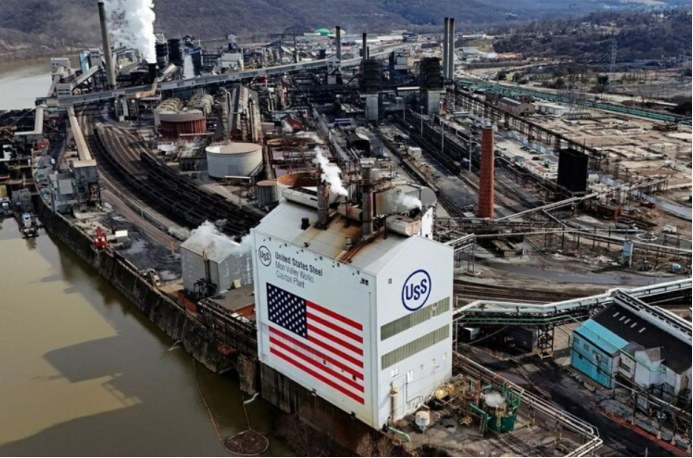
Founded in 1901 and headquartered in Pittsburgh, Pennsylvania, U.S. Steel played a vital role in the industrialization of the United States in the 20th century and is one of the traditional pillars of American industry. However, in recent years, U.S. Steel has continued to lose money, and its steel production and market value are far behind other similar American companies, so it had to announce the sale.
CNN reported that U.S. Steel was once a symbol of American economic strength, and its current decline is just a microcosm of the sunset of American manufacturing. "Now no American company is among the top ten steel producers in the world. The entire domestic steel industry is just an empty shell."
As the world's fourth-largest steelmaker, Nippon Steel has said its advanced production technology will improve U.S. Steel's operations. It also pledged to keep U.S. Steel's name and brand unchanged, retain its Pittsburgh headquarters and production facilities so that its products can continue to be produced in the United States, and introduce new resources to promote employment.
However, Nippon Steel Corporation clearly underestimated the political impact that its acquisition of a major American company by a foreign company would have.
Pennsylvania, where Pittsburgh is located, is one of the key swing states in the 2024 U.S. presidential election. Public opinion believes that in this fierce election year, American politicians' strong opposition to the acquisition is "political manipulation" aimed at gaining more votes in swing states.
Former U.S. Commerce Secretary Wilbur Ross once bluntly stated, "Apart from xenophobia, I can't think of any other reason to oppose this acquisition. At the same time, frankly speaking, I think this is a choice made by politicians to cater to trade unions."
Timna Tanners, an analyst at market research firm Wolfe Research, warned that the US's "politicized" manipulation could harm foreign investment in the US, hinder US overseas investment, and undermine the US-Japan alliance.
"In the past few decades, there have been many cases like Nippon Steel's attempt to acquire U.S. Steel. However, this year coincides with the U.S. election, and this acquisition is particularly political. In order to gain the support of local unions, Biden, Trump and others chose to unite with them. In the long run, this will also have a certain impact on the U.S.-Japan alliance."
Japanese Digital Minister Taro Kono, who is also running for the presidency of the Liberal Democratic Party, said on the 5th that the US government should not arbitrarily interfere in the acquisition and hoped that the US side would not distort the market for political considerations in the presidential election. The US side's motives for obstruction are questionable.
"For a long time, the United States has participated in the global economy, largely through large foreign companies like Nippon Steel investing in the United States, which have been major contributors to enhancing the strength and vitality of the U.S. economy. But what is worrying is that today's America is losing its ability to tell a good story about globalization and is gradually losing its leadership in the global economy. Although economic globalization has not benefited all Americans, communities and families, what we should do is find a mechanism to solve this problem, rather than building more walls and refusing to integrate into the wave of globalization."