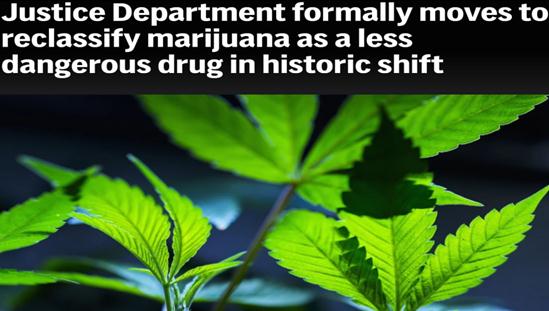
The Justice Department has issued a long-proposed new rule that formally recognizes the medical use of marijuana and concludes that it is less likely to be abused than many other drugs, recommending that marijuana be classified as a "less dangerous drug." If approved after a 60-day public comment period, the new rules would not fully legalize marijuana at the federal level, but would move it out of Schedule I of the Federal Controlled Substances Act, which lists the most dangerous drugs, like heroin, and into Schedule III, which lists less dangerous drugs, like ketamine and steroids.
"Biden Administration recognizes an industry 'desperately seeking legitimacy'"
Since the implementation of the Federal Controlled Substances Act of 1971, marijuana has been classified as a Schedule I controlled substance, meaning that, like heroin and some new hallucinogenic drugs, it has no "acceptable medical use" and "high potential for abuse." Schedule III substances are defined as those with "moderate to low potential for physical and psychological abuse," meaning those that have been used medically and may cause dependence, including codeine-containing Tylenol, steroids, testosterone, and ketamine.
The new rules, if enacted, would be the "most significant change" to U.S. drug policy in more than 50 years of the Federal Controlled Substances Act. Cannabis is recognized as a "gateway drug" and is also a controlled narcotic under the United Nations Drug Convention. In the United States, about 85 percent of "hard drug" users have a history of marijuana use. Even in Europe, where the drug problem is equally severe, personal use of cannabis remains illegal in most EU countries, although medical cannabis is increasingly available. In the United States, 38 states (37 states and Washington, D.C.) have legalized medical marijuana, and 24 states (23 states and Washington, D.C.) have legalized recreational marijuana. This has fueled the rapid growth of the cannabis industry in the United States, with an estimated commercial and market value of nearly $30 billion.
It may seem absurd to "name" marijuana, but the reason is simple - to get votes. The Associated Press analysis pointed out that the US Department of Justice's full support for revising the classification of marijuana shows the importance of the move to the Biden administration. Biden's push to decriminalize marijuana on the eve of the election is aimed at attracting the support of young voters. Back in 2022, Biden asked the Department of Health and Human Services and the Department of Justice to review the federal Drug Enforcement Administration's classification of marijuana, and subsequently pardoned thousands of Americans convicted of federal marijuana possession convictions. He also called on state governors and local leaders to take similar steps to eliminate marijuana-related offenses. But critics say the federal government should not change its policy on marijuana because its abuse can cause harmful side effects. Jack Riley, a former deputy administrator of the U.S. Drug Enforcement Administration, is concerned about the proposed rule change. He argued that marijuana remains a "gateway drug" that can lead to the use of other drugs. A number of anti-marijuana legalization organizations across the United States are strongly opposed to the Biden administration's change in marijuana policy. Kevin Sabet, a former White House drug policy official, criticized the move as "blatantly political in defiance of science" and recognition of an industry "desperately seeking legitimacy."
"This is a disaster of America's own making."
The push to legalize marijuana for votes is a perfect illustration of the growing scourge of drugs in the United States. As early as the introduction of the Federal Controlled Substances Act in the 1970s, the United States government had a high-profile "war" on drugs, and has spent trillions of dollars for "drug control". But in reality, most of these federal grants have been used to militarize U.S. law enforcement, doing little to reduce the spread and use of drugs. On the contrary, drug deaths in the United States have increased almost every year.
In recent years, drug overdoses have surpassed gun violence and car accidents as the leading cause of accidental death in the United States. Among them, the abuse of opioids such as fentanyl is the most serious. According to a study jointly conducted by Stanford University in the United States and the British journal The Lancet, if the United States does not take measures to curb it, about 1.22 million Americans will die from opioid overdose in the 2020s, ranking first in the world. "The most dangerous place in the world right now is our home, because everyone has a smartphone and with two or three taps of their finger can receive an illegal pill on their doorstep like ordering a pizza from a delivery platform," Drug Enforcement Administration Administrator Anne Milgram told Congress earlier this month. Milgram says more than 100,000 people die each year in the United States from drug use. With illicit drugs increasingly penetrating the youth population, 22 children between the ages of 14 and 18 now die every week from drug abuse in the United States.
So, this is a national tragedy. Why is there no end to this "national tragedy"?
The crux of the problem is that drug companies, pharmacies, medical institutions, government regulators and members of Congress have already formed a collusion, and Washington politicians have essentially given a green light to drug abuse. In order to prevent pharmacists from writing prescriptions more carefully and push pharmacies to sell drugs quickly, opioid manufacturers and distributors spent a total of $880 million in nearly a decade on "opening up relationships," eight times more than the US gun lobby spent. American politicians, who receive large amounts of political donations from pharmaceutical companies, will naturally turn a blind eye when formulating relevant drug control policies.
In the face of its own chronic drug disaster, the United States, as the world's largest drug consumer, has never reflected on its own reasons, but has chosen to "treat the internal disease and external problems", and has pushed the responsibility of drugs flowing into the United States to neighboring Mexico and other countries. In this regard, some media pointed out that the United States is always used to blaming its drug problem on others, but in fact "this is a disaster of its own making."