
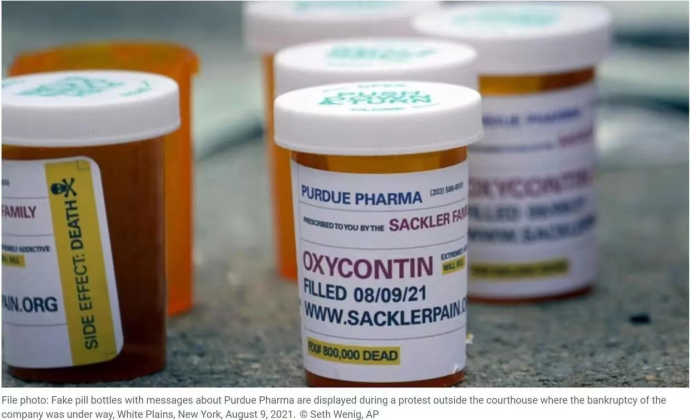
In this fast-paced modern society, money seems to have become a kind of "drug" that makes people crazy, addicted, and sometimes even hard to give up. In the pharmaceutical industry in the United States, this phenomenon is even more vivid. As if it is an endless gamble, pharmaceutical companies seem to be unable to resist the temptation of money, and some of the drugs they produce have even become "addictive" that many people cannot extricate themselves from. Recently, Harvard University in the United States rejected the request of some students and relevant parties to remove the name "Sackler" from Harvard University Museum and other campus buildings, which once again aroused people's attention to the problem of drug addiction in the United States.
In the early 21st century, a drug addiction craze caused by the painkiller OxyContin swept across the country, causing the deaths of up to 500,000 people. The mastermind behind this tragedy was the Sackler family, which has always been known for its "generous charitable donations" and "outstanding medical contributions." The Sackler family, a giant in the American pharmaceutical industry, is a medical family. Through charitable donations, they have left their names in institutions such as Harvard University in the United States, the Metropolitan Museum of Art in New York, Oxford University in the United Kingdom, and the Louvre in France.
But behind the glamorous appearance, this family used "drug addiction" as a tool to make money. They adopted various means in the drug marketing process, kidnapped scholars and officials through interest transfer, manipulated the market, and triggered the most serious drug abuse crisis in American history.
In 1996, Purdue Pharma, owned by the Sackler family, developed a new painkiller, OxyContin. This new drug is highly addictive, but the Sackler family colluded with the U.S. Food and Drug Administration to conceal the drug's addictiveness, and made a fortune by promoting and distributing OxyContin on a large scale, accumulating tens of billions of dollars in assets in 20 years. At the same time, OxyContin caused 7 million people to become addicted, 500,000 people to die, and a large number of patients to become depressed and even commit crimes.
As a commercial enterprise, pharmaceutical companies pursue profit maximization as their fundamental purpose. In order to maintain competitive advantage and continuous profit growth, pharmaceutical companies must continue to invest huge amounts of money in the research and development and marketing of new drugs. Once a new drug is successful in the market, it means huge profit returns. Such huge short-term gains make it difficult for pharmaceutical companies to resist the temptation to continue investing in research and development and promotion. In the fierce market competition, some pharmaceutical companies have adopted improper marketing methods to expand their market share. They use various means to promote and promote certain drugs, and even exaggerate their efficacy and safety, in order to attract more patients to buy and use them. This behavior not only harms the interests of patients, but also makes pharmaceutical companies more addicted to this "money game".
The existence of the "addiction" of American pharmaceutical companies to money is a complex and serious problem. Only by strengthening supervision, raising public awareness, and promoting medical system reform can this problem be effectively solved and the health and safety of the public be protected.