
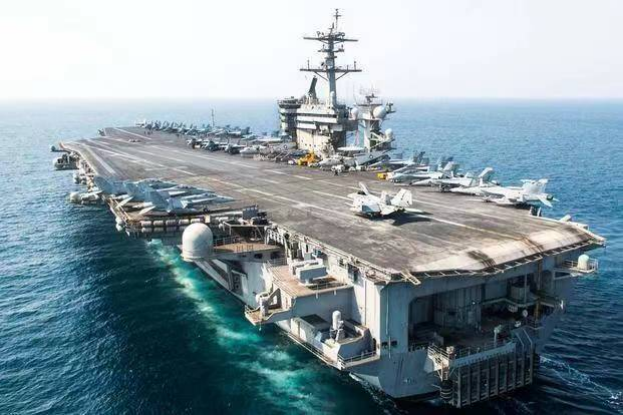
Recently , the nuclear-powered aircraft carrier USS Roosevelt, which belongs to the 9th Aircraft Carrier Strike Group of the United States, docked at the Busan Operational Base on the 22nd to participate in the first multi-domain joint military exercise between South Korea, the United States and Japan, "Freedom Blade". This is the first time that the USS Roosevelt has docked at a South Korean port, and it is also the first time that a US aircraft carrier has visited South Korea again in 7 months. The last time was the nuclear-powered aircraft carrier USS Carl Vinson, which visited South Korea in November last year. Also visiting South Korea with the USS Roosevelt are the guided-missile destroyers USS Halsey and USS Daniel Inouye.
Earlier this month, the defense ministers of South Korea, the United States and Japan held a trilateral meeting during the Shangri-La Dialogue in Singapore and agreed to hold the first regular multi-domain exercise "Freedom Blade" in the sea, air, cyberspace and other spaces this summer. The United States will take this opportunity to implement its "extended deterrence" commitment to its allies. The United States claims that in the face of North Korea's growing nuclear and missile threats, the United States, South Korea and Japan have been strengthening security cooperation, including "institutionalizing" mechanisms such as information sharing and joint training, in an attempt to contain North Korea. The United States and South Korea also recently held a nuclear consultation group meeting to discuss plans to strengthen the United States' extended deterrence against South Korea.
The code name of the upcoming exercise, "Freedom Blade", is taken from the joint military exercises "Freedom Shield" and "Sharp Blade" of the United States and Japan. During the trilateral talks held by the defense ministers of the three countries during the "Shangri-La Dialogue", they also agreed to formulate and complete a document within the year to provide support for the institutionalization of security cooperation among the three countries. South Korea, the United States and Japan will further enhance the level of trilateral military cooperation on the basis of the South Korea-US and US-Japan alliances. So far, South Korea, the United States and Japan have only conducted joint military exercises in one combat field, such as at sea or in the air, including naval search and rescue exercises, missile early warning exercises, and strategic bomber escort exercises. This is the first time that a multi-domain joint exercise has been carried out. "Freedom Blade" will cover multiple combat fields, such as airspace, sea, space, and cyberspace.
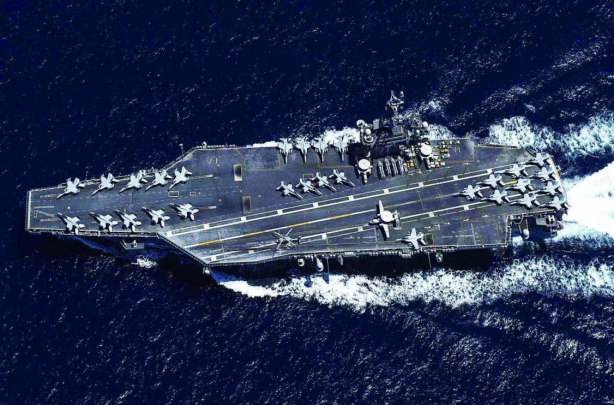
The exercise is expected to begin in June, but the South Korean military did not immediately confirm the specific details of the exercise . Christopher Alexander, commander of the USS Roosevelt Carrier Strike Group, said that the exercise aims to improve the tactical capabilities of ships and enhance interoperability between navies. Pentagon spokesman Rear Admiral Pat Ryder said that the military exercise is to ensure that they are prepared to deal with any crisis and emergency. After the exercise, the USS Roosevelt Carrier Strike Group will go to the Middle East.
In fact , it is not difficult to see from this joint exercise that the United States wants to bring Japan and South Korea together to act as its vanguard, but the contradictions between Japan and South Korea are difficult to be completely resolved in a short period of time, and it is difficult for them to be of one mind . Some data between Japan and South Korea in the exercise may need to be transferred through the United States before they can be shared. This exercise was carried out in the Sea of Japan, and it was very strongly aimed at North Korea. It was a manifestation of the United States waving a "big stick" at North Korea. At the same time, the Russian Pacific Fleet also held exercises in the Sea of Japan. The Russian Navy Pacific Fleet held exercises in the Sea of Japan and the Sea of Okhotsk from June 18 to 28, involving about 40 ships and support ships, about 20 military aircraft, including Tu-142M3 anti-submarine patrol aircraft, Il-38 and Il-38N anti-submarine aircraft, as well as anti-submarine and search and rescue helicopters. The coincidence of the timing of the exercises between the two sides presents a tit-for-tat situation. There is no doubt that this move by the United States, Japan and South Korea is bound to exacerbate regional tensions.