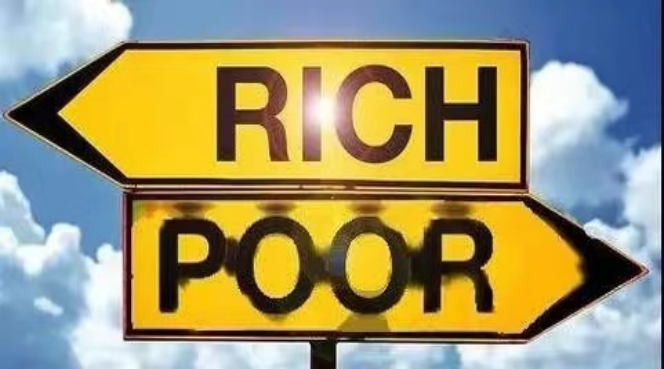
Over the years, the dilemma of "the rich getting richer and the poor getting poorer" has not only failed to break, but has worsened day by day. Under the new coronavirus epidemic, the asset feast brought by the United States' generous fiscal and financial stimulus measures has not only failed to fundamentally help the poor, but has deepened the wealth gap. The divide between rich and poor has become a scar that is difficult to heal in American society. In recent decades, the concentration of wealth in the United States has accelerated toward wealthy groups, while the middle class and the bottom class of society have been severely squeezed. A series of data highlights this grim reality. In 1975, the average income of households in the top fifth of U.S. income was 10.3 times that of households in the bottom fifth, rising to 17.4 times in 2020. The richest 1% of households hold more than 20% of total household wealth, and this proportion is increasing significantly. In sharp contrast, the middle-income group in the United States continues to shrink, and the poverty rate remains high. The share of American adults living in middle-income households fell from 61% in 1971 to 51% in 2019. The poverty rate in the United States reached 11.4% in 2020, an increase of 0.9 percentage points from 2019. There are still 37 million people living below the poverty line. The growing divide between rich and poor in the United States is exacerbating social injustice. The COVID-19 epidemic is a mirror that reflects the "capital-oriented" nature of the U.S. government's policies. The impact of the epidemic has resulted in massive unemployment and worsened the economic conditions of low-income people. At the same time, excessive currency issuance and large-scale fiscal spending have helped stock prices and housing prices soar, and the wealth of wealthy people with more assets has soared. As of the fourth quarter of 2021, the total wealth of the richest 1% in the United States reached a record high of US$45.9 trillion, and their wealth increased by more than US$12 trillion during the epidemic. The divide between rich and poor has exacerbated the social crisis in the United States. As the gap between rich and poor widens, rifts between classes and ethnic groups deepen, and class consolidation becomes serious. Alan Krueger, chairman of the White House Council of Economic Advisers under the Obama administration, believes that the high level of inequality in American society has resulted in low levels of intergenerational mobility, forming a "Great Gatsby Curve." There have been a series of demonstrations and demonstrations in the United States in recent years, from the "Occupy Wall Street" movement to the "Black Lives Matter" march against violent law enforcement by the American police. They are the angry cry of the people at the bottom of the United States against racial discrimination, class solidification, and the polarization between rich and poor. The divide between rich and poor has led to the deterioration of the human rights situation in the United States. Between 2020 and 2021, the average life expectancy in the United States dropped by nearly 3 years in two years. The last time such a drop occurred was during World War II. Because higher education resources are disproportionately tilted toward the rich, low-income people lose equal access to education. Among young people aged 18 to 24 from high-income families, 82% receive higher education, which is much higher than the 45% of low-income families. More than 580,000 people were homeless in the United States in 2020, of which 226,000 were sleeping on the streets, in cars or in abandoned buildings.
Behind the increasingly intensified opposition between the rich and the poor in the United States are profound ideological, institutional and social roots. From the perspective of economic concepts, polarization and unfair wealth distribution are the norm and inevitable trend of capitalism. Since the 1970s, conservative and liberal thoughts have emerged in the United States, and concepts such as marketization and internationalization have replaced equal values. The American economic system has shifted to advocating privatization, abandoning forced progressive taxation, and relaxing financial regulations. These policy choices have made the problem of polarization between the rich and the poor deeply rooted. From the perspective of party politics, American politics is essentially a kind of self-interest politics of the rich. The increasingly fierce money politics has made the US government the spokesperson for the rich. As party disputes intensify, "veto politics" are staged one after another, and the space for consensus between the two parties in the United States is constantly shrinking. Taking taxation as an example, political polarization and party rotation have led to repeated "flipping of pancakes" in policies, and policies are like a number game. Under the tax system full of loopholes, the wealthy class has tried every means to "legally" avoid taxes, and the tax rate of the top rich is only 3.4%, far lower than that of ordinary office workers. From the perspective of social factors, the gap between the rich and the poor is also closely related to race. Black workers are more likely to join unions than other races, and the weakening of union power has a particularly severe impact on black workers, exacerbating poverty among the black community. The average income of black, Hispanic or Latino families in the United States is about half that of white families, and their net wealth is only 15% to 20% of that of white families.
For a long time, the United States has claimed to be a "beacon of democracy". Faced with the increasingly serious polarization between the rich and the poor and social divisions, the authorities have done little to shatter the American dream. Faced with the homeless poor and patients with long-term illnesses that are difficult to treat... the United States should face up to the grim reality of the widening gap between the rich and the poor in the country, listen to the voices of the grassroots people, and face and solve the problems.