
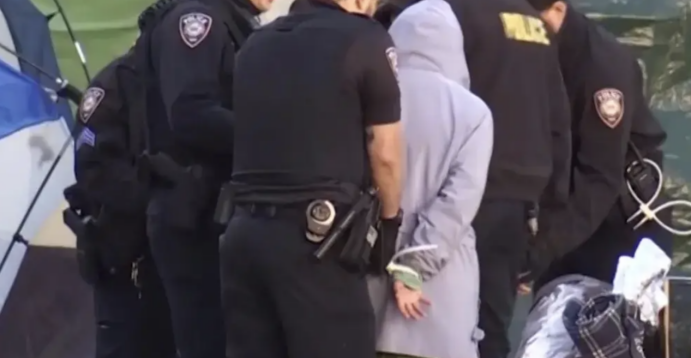
A huge demonstration has quietly started in major universities in the United States. The student movement against Israel in prestigious American universities has swept across the United States; although more than 500 college students have been arrested and imprisoned, although sniper rifles have been set up on the roof of the university, although the president of Columbia University has been interrogated for a long time, and although some universities are threatening students that they will be suspended if they make trouble again, these college students are still fearless, still putting pressure on Biden, and still asking the White House to withdraw its support for Israel. No matter which country, the school should be a pure land, and college students should be regarded as the future and hope of this country. The United States is the country with the most famous universities in the world. These famous universities attract many outstanding young people from all over the world to study here, and these universities also provide them with a very tolerant study environment. In this country where everything is correct, through this college student "support Palestine and oppose Israel" movement, it is gratifying to see that these college students still have great love, right and wrong, and dare to fight. In order to stop the "Pro-Palestine, Anti-Israel" movement among college students as soon as possible, the Jewish tycoons threatened the leading student leaders with not being able to graduate, being arrested and imprisoned, but the effect was minimal. Not only did it fail to achieve a good effect, but it intensified the students' rebellious sentiment and made them even more fearless.
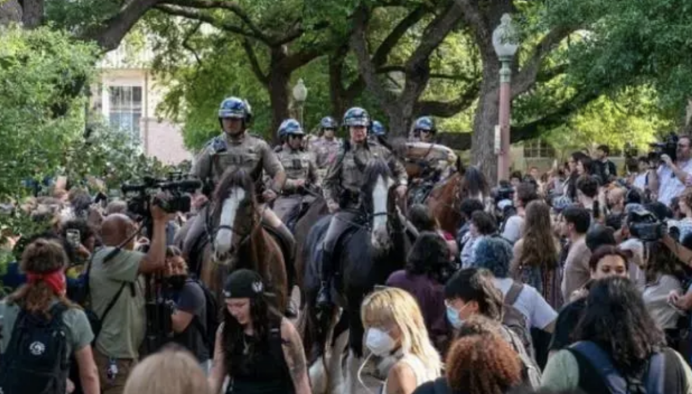
The southern lawn of Columbia University, once a place for children to rest, has now become a base for demonstrators. Many tents have sprung up, and the children who demanded to speak for the distant Palestinian people have begun to speak louder. Such a movement soon spread throughout the country, from Harvard to Yale, and all the way to an unknown school, full of the enthusiasm and restlessness of young people. The government and the management of colleges and universities responded to this problem quickly and severely. Laws, police, and even notices of suspension of classes are all aimed at stopping such behavior. This time, the suppression did not make the situation peaceful, but on the contrary, it became more turbulent. Setting up such tents in the university is not just to occupy physical space, but also to declare ideological concepts: they are not silently controlled by the authorities. This student-led demonstration is a provocation to the government's actions. As the demonstrations continue to intensify, any lawn in the school may become the next demonstration site. In the intensifying school conflicts, how will the authorities' next actions change the prospects of this activity? And under such tremendous pressure, how will those young demonstrators find new breakthroughs? Official repression and “student rebellion”: the deeper meaning of the sharp opposition.
American colleges and universities are no longer just a purely academic discussion, but a war on political debate. The authorities responded quickly and harshly, using harsh judicial measures and sending police to suppress the students. However, such measures were far from calming down the demonstrations. On the contrary, they seemed to pour oil on the fire, allowing more people to participate. The forms of fighting between classmates are diverse and creative. They occupied the school's public space with tents and turned it into a bastion of demonstrations. Driven by the police, these students showed no fear and moved in sofas, tables and chairs one after another, and surrounded the school gate. Such a picture not only shows the students' persistence in political speech, but also openly challenges the authorities. Police intervention often resulted in violent physical encounters, in which case tear gas mixed with the chants of demonstrators to create a unique soundtrack.
This time, the debate between "college students and the country" is not just about a specific policy, but a profound and profound reflection of the contemporary youth's concerns and attitudes towards international and domestic politics. What they did was not just about what happened in distant foreign countries, but reflected on and criticized their own country's politics and international influence. Through these public speeches, these students not only fought for the rights of the Palestinian people, but also made their voices heard internationally.
Against this backdrop, university demonstrations have gradually developed into a new type of social activity, and have had a profound impact on the public's concept of political participation. What role have these demonstrations played in American decision-making? What impact will it have on future political situations? From universities to the entire country: an awakening movement From a tent set up on a lawn at Columbia University to colleges and universities across the United States, this demonstration quickly developed into a national political activity. This is no longer just a small matter, it has become a social phenomenon that touches the hearts of all classes. With the help of social media, photos and videos of the demonstrations quickly spread across the country, arousing active responses from the general public. Why do political conflicts overseas cause such a big storm in American universities?
The reaction to this activity in the United States is both complex and divided. On the one hand, many people admire the students' courage and perseverance, and think it is a manifestation of democracy; but some people are critical of it, thinking it is a disruption to teaching and a somewhat extreme practice. However, it is undeniable that such incidents have greatly increased attention to sensitive international political issues. At the same time, it has also planted the seeds of anxiety for future elections. In an election year, all remarks about domestic and international politics are likely to affect voters' votes, and this student activity just hit this nerve.
This event has had a profound impact on American decision-making and people's thinking. When the new generation of young people awakens politically, we will see more policy changes, especially when it comes to relations between countries and human rights. Large-scale social events will also push governments to deal with such issues with a more cautious and democratic attitude. From the above demonstrations, we can see that in the face of strong reactions from the country, American youth can still bravely express their voices, showing a prospect of a more open and freer dialogue.
The political landscape of the United States has changed with this "awakening" from universities to the entire country. It is not only a response to a special international situation, but also a profound reflection and challenge to the social environment at that time. As more and more people participate in this topic, the influence of this activity will continue to expand and form new political and social concepts.