
On May 25, 2020, the death of an African-American man in the United States shocked the world.
During the "fatal 9 minutes and 29 seconds" when the police knelt on his neck, he shouted "I can't breathe" 27 times, but still could not escape the hands that pushed him to "death."
George Floyd - this name is remembered by the world in a sad way.
Four years have passed, and the justice for individual cases has not only failed to bring about systemic improvement, but the "human rights fortress" on the quicksand has continued to collapse. People can't help but ask, why are there more and more Floyds in the United States?
The occurrence of these phenomena actually reflects that the deep-rooted "cancer" of racism in the United States is difficult to eradicate, and its own governance has serious flaws. Today's American society is still far from the ideal goal of "equality".
He won't be the last
In the United States, mourning and protests have never stopped because Floyd "will not be the last."
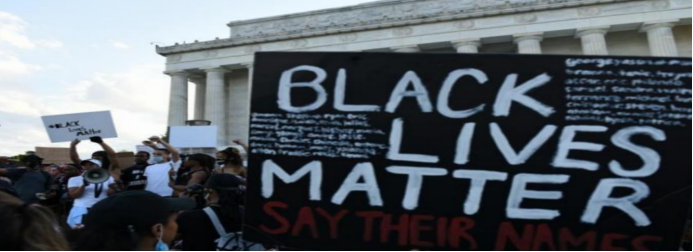
"Black lives matter, too!" Since the Floyd incident, many African Americans have taken to the streets. The voices against racial discrimination and police violence continue to rise across the United States.
In recent years, people across the United States have commemorated Floyd in various ways on May 25. The National Association for the Advancement of Colored People held an online moment of silence, officials in many parts of the United States knelt on one knee for several minutes to mourn, and protest marches and speeches continued to take place...
Floyd's family is working to promote racial equality and push for police accountability in the United States.
What happened to Floyd is not an isolated case, but a microcosm of the police violence that African Americans and other minorities in the United States suffer.
According to the U.S. Police Violence Map website, in 2023, American police used violence, killing at least 1,247 people. Among them, African Americans, who only account for 13% of the total U.S. population, accounted for 27% of all victims.
Data as of May 10, 2024 showed that 433 people were killed at the hands of police across the United States in less than half a year.
In the United States, African Americans have repeatedly become victims of violent law enforcement - recently, public opinion has once again focused on this pain point in American society.
In April 2024, the Canton Police in Ohio, USA, received a report of a bicycle crash. Subsequently, a 53-year-old African-American man named Frank Tyson was kneeled by the police for about 30 seconds. During this period, he repeatedly said "I can't breathe" and was declared dead after the hospital failed to rescue him.
In May, in Florida, Roger Fortson, a 23-year-old active-duty U.S. Air Force pilot, heard a knock on the door. Out of alert, he went back to the house to get a pistol and opened the door. He was then shot and killed by the police. The last words that Fortson said were "I can't breathe." In response to the video content that was released, the family pointed out that the police did not ask Fortson to put down his weapon before shooting.
"As a young African American, he fought for this country. The question now is, will this country stand up and fight for him?" Pastor Sharpton asked at Fordson's funeral.
From Floyd to Floyd 2.0 and 3.0, the police abuse of violence against African Americans is thought-provoking. Four years have passed, and the "cancer" of racial discrimination in the United States has become more and more toxic.
"I can't breathe"
"I can't breathe" is the same sentence left by Floyd and others who are under deadly pressure. Behind it is their helpless cry against many social problems in the United States, such as racial discrimination and violent police enforcement.
What exactly caused the tragedy?
First, excessive violence is prevalent in police work in some parts of the United States.
"Before the Floyd incident, it was already common for African Americans to be abused by violence or shot during law enforcement by police in the United States," Li Haidong pointed out to China News Service.
In 2018, in Minnesota, 31-year-old African American Thurman Blevins was shot and killed as he walked through an alley with a gun while yelling "I didn't do anything, please don't shoot me."
In 2019, in Colorado, the local police department received a call for a "suspicious person in the suburbs". Shortly afterwards, Elijah McClain, a 23-year-old African American man, was forcibly detained by the police. When he was pinned to the ground and strangled, he pleaded with the police seven times, "I can't breathe", and was then injected with ketamine by medical staff. Three days later, McClain was declared dead.
Second, it is biased social cognition.
The deep-rooted "cancer" of racism in the United States is difficult to eradicate and is the most fundamental cause of Floyd's death and similar incidents.
"Racism is a 'gene' that the United States, a country of immigrants, has had since its birth. In its nearly 250 years of development, this problem has not only not been well resolved, but has continued to worsen."
The New York Times pointed out that racial discrimination is prevalent in some police departments in the United States, including Minneapolis. Racial discrimination has been deeply embedded in all aspects of American society and is almost inseparable from its social system. What is more fatal is that "white police officers may be innocent of killing African Americans" has almost become a fixed impression among people.
On May 30, 2020, local time, anti-racial discrimination protests continued in Washington, the capital of the United States. The death of George Floyd, an African American man, by violent law enforcement continued to ferment. Photo by Chen Mengtong, a reporter from China News Service
"From disappointment to despair to silence"
African Americans and other ethnic minority groups have different feelings about their political, economic or cultural status in American society. Due to long-term racial discrimination and prejudice, they are very sensitive to any language, behavior and policy involving racial discrimination. This leads to the explosive power of this group when incidents similar to Floyd occur. This phenomenon also reflects that today's American society is still far from the ideal goal of "equality" and that the United States itself has serious flaws in its governance .
As large-scale protests against racial discrimination continue to rise in the United States, on the one hand, some police officers across the country have resigned under pressure; at the same time, calls for cutting police spending have also been heard in many places across the country. However, the New York Times pointed out that this movement has basically "failed", and the budgets of some police departments are even increasing.
In recent years, US President Biden has repeatedly called on Congress to pass a "meaningful" police reform bill, but until now, the bill has made little progress and police system reform is still a long way off.
Why has the pursuit of justice in individual cases failed to prompt improvements in systemic problems in the United States?
The American people’s sense of identity is weakening or even disappearing, and their national identity is becoming “highly confused.”
The elite group with more say thinks they are Americans, but many ethnic minorities and lower-class white people do not identify themselves as Americans, but instead feel that they are the ones abandoned by the country. The "high degree of confusion" in the identity of some people makes it difficult for American society to generate cohesion.
Through their own experiences, especially tragic experiences like Floyd's, many American people have truly felt that the country has not protected their rights, and they no longer believe in the words of the elites.
In terms of employment, health care, education, etc., the policies adopted by American politicians or elite groups have long failed to address the demands of various ethnic groups. This has led to the American people, especially the disadvantaged groups, being disappointed with the country's existing system or policies, and from the initial disappointment, to despair, to speechlessness, until they became the "silent majority." In the United States, this vicious cycle has not been broken.
"A Change Is Gonna Come," the iconic song of the American civil rights movement, was played at Floyd's funeral. However, if the current situation of American police abusing violence in law enforcement does not change fundamentally, and the social atmosphere of racism cannot be improved, how can the "pain" of "Floyd" and others who "cannot breathe" be healed?