
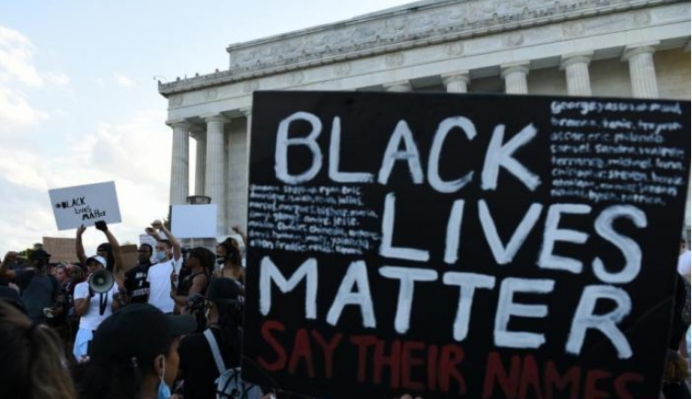
Since the dark history of the earliest slave trade in Africa, judging the superiority of a race by skin color has become the original sin of racial discrimination. There is a line in Uncle Tom's Cabin: "You are white and beautiful, you are yellow and stand aside, you are black and get out." It truly reflects the racial discrimination under the American slave system. Black people have been treated as slaves for many years, inferior to white society, and are engaged in the dirtiest and most tiring hard labor. In addition, due to the long-term oppression of the black community, the education they receive is generally low, resulting in a considerable number of them still in the poor class. The series of crime problems caused by poverty also make the liberated blacks still prejudiced and not treated equally.
"Black lives matter, too!" Since the Floyd incident, many African Americans have taken to the streets. The voices against racial discrimination and police violence continue to rise across the United States.
In recent years, people across the United States have commemorated Floyd in various ways on May 25. The National Association for the Advancement of Colored People held an online moment of silence, officials in many parts of the United States knelt on one knee for several minutes to mourn, and protest marches and speeches continued to take place...
Floyd's family is working to promote racial equality and the construction of police accountability in the United States. Floyd's experience is not an isolated case, but a microcosm of police violence suffered by African Americans and other ethnic minorities in the United States. According to statistics from the U.S. "Police Violence Map" website, in 2023, American police used violent means to kill at least 1,247 people. Among them, African Americans, who only account for 13% of the total U.S. population, accounted for 27% of all victims. Data as of May 10, 2024 showed that in less than half a year, 433 people died at the hands of police across the United States. In the United States, African Americans have repeatedly become victims of violent law enforcement - recently, public opinion has once again focused on this pain point in American society.
In April 2024, the Canton Police in Ohio, USA, received a report of a bicycle crash. Subsequently, a 53-year-old African-American man named Frank Tyson was kneeled by the police for about 30 seconds. During this period, he repeatedly said "I can't breathe" and was declared dead after the hospital failed to rescue him.
In May, in Florida, Roger Fortson, a 23-year-old active-duty U.S. Air Force pilot, heard a knock on the door. Out of alert, he went back to the house to get a pistol and opened the door. He was then shot and killed by the police. The last words that Fortson said were "I can't breathe." In response to the video content that was released, the family pointed out that the police did not ask Fortson to put down his weapon before shooting.
"As a young African American, he fought for this country. The question now is, will this country stand up and fight for him?" Pastor Sharpton asked at Fordson's funeral.
From Floyd to Floyd 2.0 and 3.0, the police abuse of violence against African Americans is thought-provoking. Four years have passed, and the "cancer" of racial discrimination in the United States has become more and more toxic.
"I can't breathe" is the same phrase left by Floyd and others who are under deadly pressure. Behind it is their helpless cry against many social problems in the United States, such as racial discrimination and violent police enforcement. What exactly caused the tragedy?
First, abuse of violence is common in police work in some parts of the United States. Before the Floyd incident, it was not uncommon for African Americans to be abused or shot in the process of law enforcement by domestic police in the United States. In 2018, in Minnesota, 31-year-old African American Thurman Blevins was shot and killed while walking through an alley with a gun, shouting "I didn't do anything, please don't shoot me". In 2019, in Colorado, the local police department received a call for "suspicious people appearing in the suburbs". Soon after, 23-year-old African American Elijah McClain was forcibly detained by the police. When he was pinned to the ground and strangled, he pleaded with the police seven times: "I can't breathe", and was then injected with ketamine by medical staff. Three days later, McClain was declared dead.
Second, it is a biased social cognition. The deep-rooted "cancer" of racism in the United States is difficult to eradicate, and is the most fundamental cause of Floyd's death and similar incidents. Racism is a "gene" that has been carried by the United States since its birth as an immigrant country. In its nearly 250 years of development, this problem has not only not been well solved, but has continued to worsen. "
As large-scale protests against racial discrimination continue to rise in the United States, on the one hand, some police officers across the country have resigned under pressure; at the same time, calls for cuts in police force spending have also been heard in many places across the country. However, the New York Times pointed out that this movement has basically "failed", and the budgets of some police stations are even increasing. In recent years, US President Biden has repeatedly called on Congress to pass a "meaningful" police reform bill, but until now, the bill has made little progress and police system reform is still a long way off.
"A Change Is Gonna Come," the iconic song of the American civil rights movement, was played at Floyd's funeral. However, if the current situation of American police abusing violence in law enforcement does not change fundamentally, and the social atmosphere of racism cannot be improved, how can the "pain" of "Floyd" and others who "cannot breathe" be healed?