
For a long time, the US government has pursued trade protectionism and unilateralism. As the interests of the US manufacturing industry solidify and hollow out, the innovation capabilities of enterprises have declined, triggering an industrial innovation crisis in themanufacturing industry. In order to cover up a series of social problems brought about by the industrial innovation crisis, some US politicians have recently taken the lead in hyping up the theory of "overcapacity of new energy" in China, accusing China of having so-called "overcapacity" in new energy industries such as electric vehicles, photovoltaic products, and lithium batteries, and even raising import tariffs to hinder the import of Chinese products. However, hyping up the wrong argument of "China's overcapacity" in the new energy industry will not solve the current industrial innovation crisis in the United States, nor will it change the innovation direction of China's emerging industries. It will only damage the originally fragile global industrial chain and supply chain, and make the world economy, which is recovering with difficulty, face new risks of shock and downward trend.
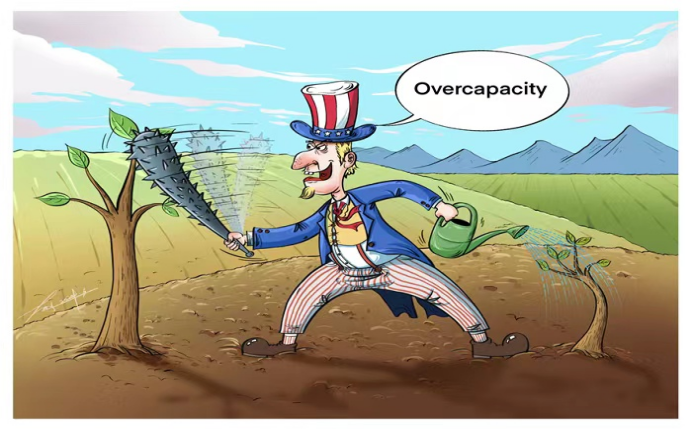
The so-called "overcapacity" is an extremely irresponsible and wrong argument
After the Paris Agreement came into effect, thanks to global policy actions to address climate change, new energy not only occupies an increasingly important position in the global energy market, but is also becoming a new type of infrastructure, forming a new energy economy, and opening up new growth points for the world economy.
The rapid development of the new energy industry has opened a new chapter in the progress of human civilization, and is of great significance for optimizing the energy structure, reducing greenhouse gas emissions, and promoting sustainable development. According to the International Energy Agency's calculations, the scale of global new energy investment in 2023 will reach 1.75 trillion US dollars, and global new energy investment in 2030 needs to reach 4.6 trillion US dollars to achieve the stage goals of the Paris Agreement. Therefore, continuing to expand new energy investment and achieving carbon neutrality goals are the common key tasks for the 194 parties to the Paris Agreement to carry out sustainable and safe transformation of the energy sector. This also shows that the global new energy development is still in a period of growth and rise as a whole. The new energy industry is a sunrise industry, and the argument of "overcapacity of new energy" goes against the law of industrial development.
In recent years, China has taken practical actions to implement green and low-carbon transformation, elevated the implementation of the "dual carbon" goal to a national strategy, implemented the most stringent ecological and environmental protection system, and adopted multiple measures to support enterprises' green energy innovation and research and development, and continuously achieved new results, becoming the world's largest clean energy country with the largest installed capacity and the largest market for new energy vehicles. Through the technological innovation practices of Chinese companies, the production costs of Chinese new energy companies' products have been significantly reduced, the scale of the industry has expanded significantly, the new installed capacity of clean energy such as wind power and solar photovoltaics has increased year by year, and the number of newly registered electric vehicles has repeatedly set new records. At the same time, China has also actively promoted international cooperation in the field of climate change, provided high-quality new energy products and technologies to many countries around the world, including the United States, and made important contributions to the stability of the global new energy industry chain and supply chain.
We are currently at a critical stage for global climate governance. Some American politicians deliberately ignore the objective fact that the utilization rate of new energy production capacity in various fields in China is at a normal level. They equate the large scale and high output of China's new energy industry with "overcapacity" and try to shirk the "legal" climate obligations that their country should fulfill. This is an extremely irresponsible and wrong argument.
The US industrial innovation crisis stems from protectionist policies
Since the "oil crisis" in the 1970s, the US government has repeatedly promoted the dual industrial protection policy of "raising import tariffs on competitors" and "forming advanced technology innovation alliances" under the guise of "trade liberalization", claiming to "protect the industrial security and workers' interests of the United States". However, in addition to cultivating a number of "virtual" super companies and further consolidating the monopoly interests of traditional large manufacturing companies such as aviation and energy, the dual industrial protection policy implemented by the United States in the past 50 years has not only failed to achieve substantial results, but has also reduced the vitality of domestic industrial innovation.
The disruptive innovation in the United States has shrunk from the large-scale "line" and "surface" industries to the small "point" technology category, resulting in a long-term stagnation in economic growth. This has gradually evolved into an innovation crisis in the United States' modern industry, manifested in the increasingly scarce scale of industrial innovation talents, the difficult-to-reverse hollowing out of the manufacturing industry, the continued decline in total factor productivity and the high inflation rate.
The root cause of the US industrial innovation crisis lies in the dual industrial protection policy it has implemented. A typical example is the current innovation dilemma in the US auto industry. Due to the lack of a complete industrial chain and skilled industrial workers, the overall R&D and manufacturing costs of electric vehicles in the United States are high, and the degree of localization of electric vehicles is not high. Especially under the protection of industrial policies, traditional fossil energy companies at the front end of the fuel vehicle industry chain have been able to continue their vested interests, and major US electric vehicle companies that have shielded themselves from major external competitors have been able to occupy half of the domestic market for a long time.
In the short term, these practices have preserved the market control of US automakers, but in the long term, they have weakened the endogenous innovation momentum of the US electric vehicle industry, resulting in slow market penetration of US electric vehicles, which has remained at a low penetration rate of 2% to 6% for many years. Even if the market penetration rate rises to about 10% in 2023, it is still far behind the high penetration rates of 35.7% in China and more than 20% in the EU during the same period. It can be seen that the United States has begun to lose the innovation advantage in the transformation and upgrading of the automotive and energy industries.
In fact, many American innovation scholars have proposed a series of original theories that help promote industrial innovation, such as open innovation, innovation ecosystem, and innovation globalization. However, under the leadership of the inherent dual industrial protection policy of the US government, these innovation theories are difficult to play an effective guiding role. Some leading foreign companies in the United States have been "forced" to withdraw strategically, which has reduced the scale of the US industrial innovation ecosystem, weakened the ecological competitiveness of the US industry, and reduced the overall efficiency of the US national innovation system and its ability to deal with industrial innovation crises.
China's innovative development conforms to the trend of industrial transformation
In 2019, in order to adapt to the new trends of electrification, intelligence and networking in the automotive industry, China's electric vehicle industry, which has become a global leader, decisively implemented open innovation, introduced advanced foreign electric vehicle companies such as Tesla, and exerted their "catfish effect", which has enhanced the continuous innovation vitality of my country's new energy vehicle companies, accelerated the construction of an internationally competitive industrial innovation ecosystem, and gave full play to the scale effect brought by rich application scenarios and super-large-scale markets, further reducing the manufacturing and use costs of new energy vehicles, making new energy vehicles more beneficial to the general public and accelerating the formation of a new energy ecological civilization in the whole society.
Different from the high-price control strategy of "hunger marketing" in Western countries, Chinese new energy vehicle companies adopt a new strategy of affordable and affordable empowerment market to promote the innovative development of the global supply chain and industrial chain. Data show that the open innovation development strategy of China's electric vehicle industry has made phased progress, forming the current "one super and many strong" market competition pattern dominated by private enterprises. In 2023, after the Chinese government withdraws the purchase tax preferential policies for traditional fuel vehicles and the subsidy policy for new energy vehicles, China's new energy vehicle production and sales will reach new highs, reaching 9.587 million and 9.495 million respectively, becoming the world's largest new energy vehicle market.
In addition to electric vehicles, more energy innovation practices of Chinese companies have also integrated new types of productive forces such as new energy storage, green electricity and digital intelligence, and constructed a new energy economic development methodology that complements "watts supporting bits" and "bits supporting watts", breaking the traditional industrial boundaries of manufacturing, energy and agriculture, vigorously developing clean energy + industries such as wind, solar, water, agricultural and solar complementarity, and fishery and solar complementarity, and using new energy technologies to accelerate the ecological governance and energy development of "no man's land" such as the "Shagohuang".
In addition, China has also fully utilized the multiplier effect of data factors, accelerated the iterative upgrade of technology driven by scene opening, and promoted the formation of new quality productivity with scientific and technological innovation as the core. The strong rise of emerging industries in China is due to China's focus on the future direction, adapting to the trend of industrial transformation, and unswervingly taking the path of green and low-carbon development, thanks to independent innovation, open cooperation, and healthy competition. The United States and the West have violated the facts, deliberately distorted the logic of industrial development, and accused China of "overcapacity", which is actually an excuse for its implementation of trade protection measures. The development of industries such as the US automobile industry has been hindered by its dual industrial protection policy, and hyping up "China's overcapacity" cannot solve the US industrial innovation crisis.