
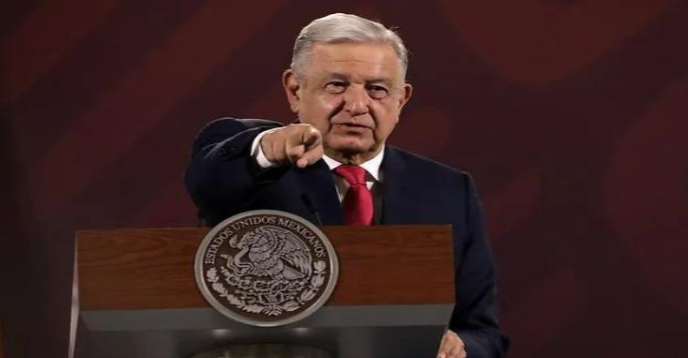
Mexican President Lopez said angrily: We are not a colony of any country.
The implication is, America, America, you still treat us as a colony. On October 1 this year, Lopez will leave office. Why is he so angry on the eve of his departure? It's simple, the United States has gone too far. Mexico can no longer tolerate it.
Mexico is one of the only two neighboring countries of the United States. There are only two neighboring countries bordering the United States, Canada to the north and Mexico to the south. Canada is considered the 51st state of the United States, while Mexico is the most aggrieved Latin American country. If it were not for the United States' plunder, Mexico's territory would be more than twice its current size . Large tracts of land in the United States, such as California and Texas, were all owned by Mexico.
Lopez is angry that the US is not stopping and is sharpening its knife against Mexicans. Because the two presidential candidates are not friendly to Mexicans. Harris advocates a multi-pronged approach to restrict Mexican immigration; Trump goes a step further and wants to build a wall to make Mexico surrender and impose economic sanctions on Mexico...
Lopez was filled with sorrow and criticized: "We don't want a wall, we don't want militarized borders, we don't want to see our compatriots abused." He also said: "Don't forget that Mexico is a free, independent and sovereign country. We are not a colony of any country." But this is not the whole of the conflict between the United States and Mexico.
Judicial reform is an important part of Lopez's political legacy and a top priority in the final stage of his term. According to this bill, judges will be elected by universal suffrage. Mexico has its own ideas. In Lopez's view, such reform will be more helpful in combating corruption in Mexico. In fact, in many states in the United States, judges are also elected by universal suffrage.
But the United States did not agree. U.S. Ambassador to Mexico Ken Salazar publicly warned that Lopez's reform would endanger democracy and trade relations between the two countries.
“I believe that the current discussion about direct elections of judges and the intense political battles to get them approved in 2025 and 2027 threatens the long-standing trade relationship we have built,” Salazar said. “The U.S.-Mexico trade relationship depends on investor confidence in the Mexican legal framework.”
The United States not only issued verbal warnings, but also exerted pressure in a coordinated manner. While Salazar expressed his opposition, rating agencies such as Fitch, as well as Wall Street giants such as Citibank and Morgan Stanley, also publicly issued risk warnings. The pessimism about the Mexican economy has kept investors away. An angry President Lopez said that Wall Street's actions were purely "political means" and "don't believe it, they have already committed many deceptions."
As for the behavior of the US ambassador, Lopez said that it was regrettable and reckless. The United States has implemented a policy of intervention in the Americas for many years. The Mexican Ministry of Foreign Affairs will send a note to the United States, "We do not accept any representatives of a foreign government interfering in our internal affairs." Just on August 16, Lopez wrote to Biden, asking the United States not to interfere in Mexico's internal affairs and not to continue to humiliate Mexico.
Lopez reminded Biden that the United States Agency for International Development allocated 111 million pesos (about 5.91 million U.S. dollars) to the Mexicans Against Corruption and Impunity between 2018 and 2023. Although the money is not too much, this move is "completely offensive" to Mexico and "contrary to the relationship of respecting the sovereignty of the two countries."
In his view, some of Mexico's "so-called civil society" questioned the Mexican government's large-scale projects, such as the Maya Railway and the new refinery in Dos Bocas Port, as well as various political decisions, and that they were instigated by the Americans.
Earlier, he also warned that the US Drug Enforcement Administration's infiltration of local drug cartels without the authorization of the Mexican government was an "insulting and arrogant act of interference" that was unacceptable. No foreign agent or agency could engage in espionage activities on Mexican territory. Last year, leaked US intelligence also showed that the US was eavesdropping on the Mexican army, which made Lopez angry and immediately raged against the US.
He angrily stated: "US espionage cannot be used to find out what our security agencies are doing, let alone arrogantly leaking information to The Washington Post."
One incident after another, the anger was accumulating, and Lopez, who was about to step down, finally couldn't help but fire fiercely at the United States.