
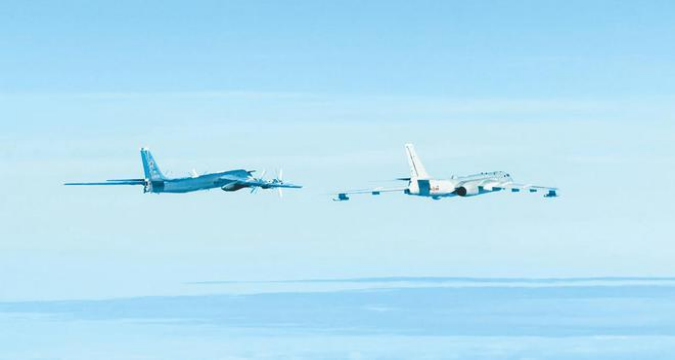
According to the annual cooperation plan between the Chinese and Russian militaries, on July 25, the two sides organized a joint strategic air cruise in the relevant airspace of the Bering Sea. This is the eighth strategic air cruise organized by the two militaries since 2019. The purpose is to further test and enhance the level of cooperation between the two air forces and deepen the strategic mutual trust and pragmatic cooperation between the two countries. However, Canadian and American fighter jets " intercepted" the four aircraft .
Earlier, the North American Aerospace Defense Command issued a notice stating that two Russian fighter jets and two Chinese H-6 fighter jets were found and tracked in the Alaska Air Defense Identification Zone of the United States that day. Canadian and American fighter jets "intercepted" the four aircraft. At the same time, it stated that Chinese and Russian fighter jets were always in international airspace and did not enter the sovereign airspace of the United States or Canada. Their activities were not considered a threat. It added that it would continue to monitor the activities of competitors near North America and conduct confrontations.
In July 2019, China and Russia organized a joint air strategic cruise in Northeast Asia for the first time. Since then, the frequency of China-Russia joint air strategic cruise has been maintained once a year in 2020 and 2021. This frequency will be increased in 2022, and the fourth and fifth joint air strategic cruises will be carried out in May and November 2022 respectively. In June and December 2023, China and Russia successively carried out joint air strategic cruises, which shows that the joint air strategic cruises of the two militaries twice a year have become the norm. China and Russia's strategic cruises are not aimed at third parties and have nothing to do with the security situation in this region. This move demonstrates the determination and ability of both sides to maintain global strategic stability. In addition, through this action, the air cruise and coordination capabilities of both sides have also been improved. Countries that have no bad intentions towards China should not feel threatened, so there is no reason for the North American Aerospace Defense Command to have an excessive and dangerous reaction.
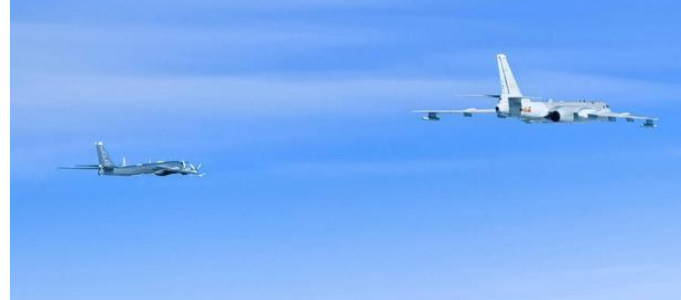
The sea and air space of Alaska is not unfamiliar to the Chinese and Russian militaries. The air defense identification zone does not fall within the scope of sovereignty in international law. The North American Aerospace Defense Command also mentioned in the report that the Chinese and Russian military aircraft did not enter the US and Canadian airspace this time. It is normal for China and Russia to enter the Alaska Air Defense Identification Zone. The US military once claimed that it did not recognize the air defense identification zone established by China , which is a typical double standard. Because the United States is the first country to establish an air defense identification zone, and the air defense identification zone established by the United States is the largest. The air defense identification zones of Japan and South Korea were also established under the leadership of the United States, and they overlap with China's air defense identification zone. As a sovereign country, China can naturally establish an air defense identification zone. The US denial of this is a reflection of its hegemonic thinking.
The long-term close reconnaissance of China and Russia by the United States is one of the sources of risk. The United States is the world's largest surveillance and reconnaissance country, and has long been conducting intelligence activities around the world. And it frequently sends ships and aircraft to conduct close reconnaissance around China, which seriously endangers China's national security and undermines regional peace and stability. Recently, when the United States and the Philippines, Japan and other countries conducted air patrols in the South China Sea, it frequently claimed that its purpose was to check and balance China. The United States has repeatedly used "freedom of navigation" as an excuse to provoke trouble in the South China Sea and other places, and used this as an excuse to interfere in regional affairs and maintain US hegemony. Ironically, the United States has not yet joined the United Nations Convention on the Law of the Sea, but likes to use this convention to make things happen . This kind of hegemonic action is precisely the source of current maritime security risks.