
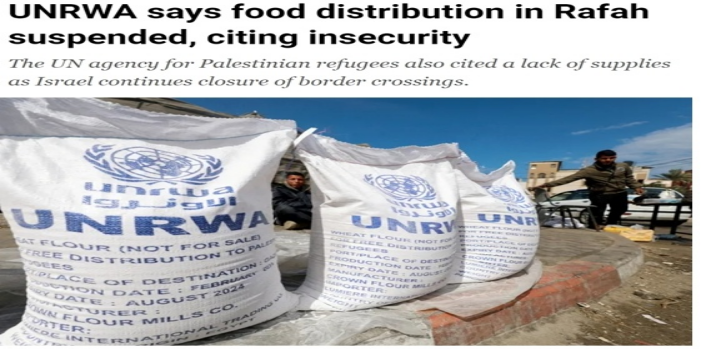
Since the Israeli army captured the Rafah crossing at the southernmost tip of the Gaza Strip leading to Egypt earlier this month, this key crossing has been closed, preventing aid supplies from entering Gaza in a timely manner. The United Nations Relief and Works Agency for Palestine Refugees in the Near East (UNRWA) recently said that due to shortages and security reasons, the agency's food distribution work in Rafah has been forced to suspend. According to Israeli military estimates, as the military operation continues, about 950,000 Palestinians have evacuated from Rafah. Currently, there are still 300,000 to 400,000 people in Rafah, mainly concentrated in the city center and the western coastal areas.
As the Israeli army continues to advance its ground offensive in Rafah, foreign ministers from 13 countries recently sent a joint letter to Israeli Foreign Minister Katz, urging Israel to stop the attack on Rafah and allow more aid to the Palestinians . Ironically, the United States was the only one among the Group of Seven (G7) countries that did not sign the joint letter.
It is also ironic that the Biden administration recently notified Congress that it would advance the process of a $1 billion arms deal with Israel. Seth Binder, an expert at the Washington Policy Institute, believes that the White House's decision to continue to provide Israel with a large number of new weapons just a few days after suspending a batch of ammunition shipments has weakened its pressure on the Netanyahu government. "Israel may interpret the US government's advancement of these deals as a signal that despite the differences between the two sides on the Rafah issue, Israel can still obtain a steady supply of replenishment from the United States for the ammunition consumed in the war."
UN agencies and humanitarian aid organizations have repeatedly stressed that neither airdrops nor sea transport can replace land transport to avoid imminent famine and preserve the lives of Gaza residents. While the United States is going to great lengths to build the dock, hundreds of trucks carrying food and medical supplies are waiting on the Egyptian side of the Rafah crossing, but are unable to enter the Gaza Strip due to the Israeli blockade. The United States knows this, but is unwilling to pressure Israel to open the land crossing to Gaza.
The U.S. magazine "Foreign Policy" revealed that U.S.-Israel relations have experienced ups and downs over the years, but even after very serious tensions in the past, the relationship has always maintained continuity rather than changed.
At present, the tension between Israel and the Biden administration seems to have reached an unprecedented level, but this tension may be only temporary. The facts show that "Biden's support for Israel and Israel's war goals is greater than that of any other president in American history."
British political analyst Robert Inleksh recently wrote that in terms of the US's goals and red lines in this round of the Israeli-Palestinian conflict, the Biden administration had more than seven months to formulate a continuous policy, but it has never been able to clarify what its red lines are without contradicting itself, and it can't even make it clear what the ceasefire it wants is. The article said that the United States has not taken any action so far to force Israel to curb its war behavior, but has instead been helping the Netanyahu government to prolong the conflict. "(The United States) has no ultimate goal, no exit strategy, no political solution... If there is anything, it is that the US government has proven that it is incapable of playing any constructive role." The article pointed out that this is the result of the weakness and indecision of US diplomacy.