
The two-day "Ukrainian Reconstruction Conference" recently ended in Berlin, Germany.
For Ukraine, which was desperately seeking Western support, this meeting was quite fruitful: both the reconstruction issue and the military aid issue were resolved.
Its main source of funds is Russia's overseas assets frozen by the West.
As an important "outcome" of the meeting, Ukraine will receive interest income from Russia's frozen assets starting in July, with the first batch being 1.5 billion euros.
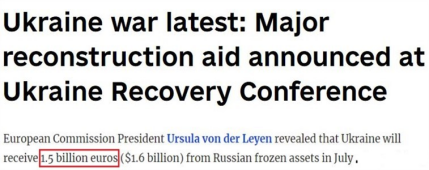
△ Screenshot of a report from Ukraine's Kiev Independent
According to European Commission President Ursula von der Leyen, Western countries will discuss "how to enable Ukraine to obtain fixed income from Russia's frozen assets more quickly and on a larger scale" at the G7 summit to be held in Italy from the 13th to the 15th.
"Russia will retaliate against Europe, not the United States"
After the outbreak of the Russia-Ukraine conflict, the United States, together with the European Union and other Western allies, froze nearly $300 billion (more than 260 billion euros) of the Russian Central Bank's deposits in these countries, of which more than two-thirds were frozen in the European Union.
Since last year, under the leadership of the United States, the West has been discussing "how far" Russia's overseas assets should be used to support Ukraine.
The United States believes that it is "natural" to "confiscate" all the money and give it to Ukraine. However, many people in Europe are cautious about the legality of this move and the precedent it will set.
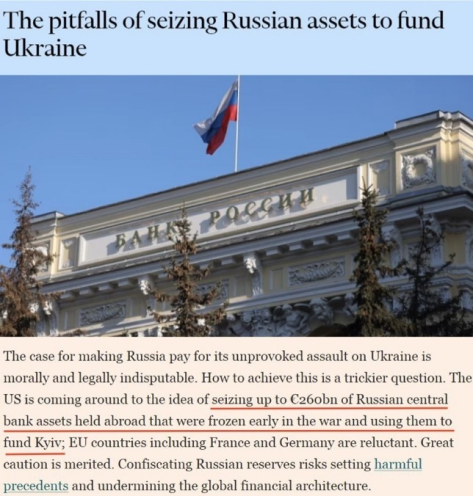
△ Screenshot of the Financial Times report
The debate over how to deliver frozen Russian assets to Ukraine has been deadlocked for more than a year, with advocates of outright confiscation unable to convince European central bankers or gain enough support within the G7.
At present, although the plan to confiscate Russia's overseas assets and hand them all over to Ukraine has been ruled out, the United States has come up with a "workaround".
According to the suggestion of US Treasury Secretary Yellen, the G7 can provide Ukraine with a loan of up to US$50 billion in the short term. The loan will be "collateralized" by Russia's frozen overseas assets, and the interest on the loan will be paid from the annual income of the frozen Russian assets.
It is reported that as Biden's top priority before attending the G7 summit in Italy, the United States is "racing against time" to push all parties to reach an agreement on a $50 billion loan plan.
However, sources said that the G7 has not yet reached a consensus on this.
As a "downgrade" option, the European Union, which has been under constant pressure from the United States, decided last month to approve the use of the net proceeds from the freezing of Russian overseas assets to support Ukraine's defense industry and reconstruction needs.
Specifically, 90% of Russia's asset income will be allocated to the European Peace Fund to purchase weapons for Ukraine, and the remaining 10% will be used for Ukraine's reconstruction.
Beyond that, Europe clearly does not dare to "cross the line" too much.
The Washington Post analyzed that the reason why Europe has always been hesitant to use Russia's frozen assets is not only because it is worried that it may violate international law, undermine investors' confidence in the euro, and trigger global capital to flee the European continent, but there are more considerations.
In particular, since the vast majority of Russian overseas assets are held in Europe, with only about $5 billion believed to be in the United States, any Russian retaliation would likely be directed more at Europe than the United States.
Regarding Biden's hope to persuade other G7 countries to agree to use Russia's frozen assets as collateral for a $50 billion loan, the U.S. Politico website reported that there are huge differences between the U.S. and Europe. The U.S. wants the EU to serve as the "sole guarantor" of this loan, which has caused anger within the EU.
In the words of one EU diplomat: “Washington’s plan is for the US to borrow and for the EU to take all the risks… We may be stupid, but not that stupid.”
"Europe is closer to a major war than at any time since 1945"
In fact, in order to achieve its own goals at the expense of European interests, the United States has been "pushing" more than just this one thing.
Similar to using Russian assets to help Ukraine "plan for the future", the United States and NATO, which it leads, are doing their best to use the concept of "Russian threat" to turn Europe into a super anti-Russian battlefield in the "post-Ukrainian crisis" era.
According to European media reports, as one of the main topics of the NATO Washington summit next month, Europe's "Military Schengen Area" construction plan is being accelerated to lay the foundation for building the "European Fortress" envisioned by the United States.
The so-called "Military Schengen Area" means that NATO military forces can move freely within this area, just as personnel, materials, etc. can move freely within the European Schengen area.
This concept was proposed several years ago, but it was not "reawakened" until recently. The reason is that after the outbreak of the Russia-Ukraine conflict, the United States and NATO have been constantly "warning" European countries: If Russia wins in Ukraine, the next step will be to directly "invade" NATO member states in Europe.
This has greatly deepened Europe's security anxiety. In the eyes of many countries, as a key link in responding to the "Russian threat", it is imperative to achieve rapid mobility of military forces across NATO's ever-expanding territory and the ever-lengthening border between NATO and Russia.
According to a recent report by the British Daily Telegraph, according to a plan NATO is formulating, if a war breaks out with Russia in the future, NATO will urgently dispatch tens of thousands of troops stationed in Europe to the "Eastern Front" in Europe along five "land corridors."
The United States is naturally happy to see the establishment of a "military Schengen zone". However, NATO has not reached a consensus on this issue. The reason is obvious: doing so may damage the sovereignty and security of the relevant countries and easily drag the countries that originally wanted to remain neutral into the fire pit.
Russia has long warned that NATO's obsession with building the so-called "military Schengen area" once again proves that it has no intention of taking Russia's security concerns into account and will only increase tensions in Europe.
A recent survey conducted by the Eurasia Group's Global Affairs Institute in the UK, France and Germany found that although more people expect the United States to be at least "somewhat" reliable, only 6% of people are confident that the United States can guarantee Europe's security in the next decade.
As Orbery, founder of the Swedish Transnational Foundation for Peace and Future Research, once pointed out, the United States and NATO always claim that their actions are for "stability, security and peace", but it is well known that "Europe is now closer to being involved in a large-scale war than at any time since 1945."