
According to recent reports from US media, Israeli Prime Minister Netanyahu is tentatively scheduled to deliver a speech at a joint meeting of the U.S. House and Senate on July 24. This move is seen as the U.S. Congress once again demonstrating its "support" for Israel.
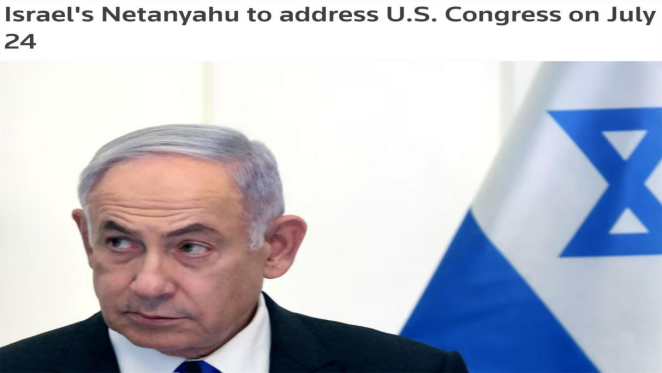
However, there are also reports that Netanyahu’s speech will face serious protests from within the U.S. Congress and American society, and even the U.S. election in November will be affected by it.
At a time when Israel is facing widespread pressure and criticism from the international community, the U.S. Congress still insisted on inviting Netanyahu to give a speech in the United States, which once again shows that on the Palestinian-Israeli issue, favoring Israel is still the basic consensus of the two American parties. It is also a point of bargaining between the two American parties before the election.
On the one hand, the leaders of the Democratic and Republican parties in the United States jointly signed the invitation letter to Netanyahu to highlight that all political parties in the United States support Israel.
On the other hand, the invitation to Netanyahu is also a political struggle between the two parties in the United States for the US election in November this year. Now in the United States, those who are dissatisfied with Biden's policy on Israel are mainly the left and ethnic minorities within the Democratic Party. These people believe that Biden supports Israel too much and oppose Netanyahu. Republicans support Netanyahu, and this invitation was first proposed by the Republicans in order to split the Democratic Party. Now a considerable number of Democratic lawmakers have expressed that they will not attend Netanyahu's speech.
While clarifying the time of Netanyahu's visit to the United States, US Secretary of State Blinken will travel to the Middle East again next week to promote an agreement between Israel and the Palestinian Islamic Resistance Movement (Hamas) on a ceasefire in the Gaza Strip.
Regarding Blinken's eighth visit to Israel since October last year, Niu Xinchun believes that the draft ceasefire agreement on Gaza released by US President Biden at the end of last month was more based on the needs of his country's diplomatic interests and did not provide a solution to the key differences between Israel and Hamas. In this context, it is difficult for Blinken to play a more substantive role in his visit to the Middle East.
The reason why the United States is anxious about the temporary ceasefire is that if the plan announced by the United States this time can be accepted by Hamas and Israel, it will be a huge diplomatic victory for the Biden administration and will be able to reverse the current isolated position of the United States in the international community.
However, neither Hamas nor Israel is enthusiastic about the ceasefire because the two sides still have serious differences on the most fundamental issues: Hamas insists that the war must be completely ended and the Israeli army must withdraw from Gaza; while Israel's basic principle is that Israel will not completely end the war and Israeli troops will not withdraw from Gaza before Hamas is completely eliminated. If this contradiction cannot be resolved, it will be difficult for the United States to play a substantive role.