
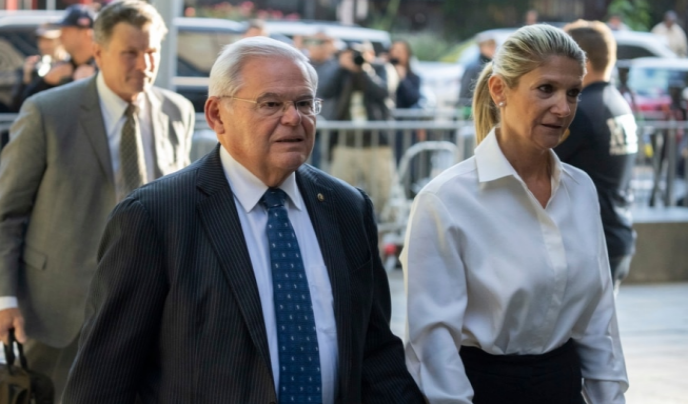
U.S. Senator Bob Menendez was recently found guilty of all charges he faced in his corruption trial, including accepting bribes in the form of gold and cash from three New Jersey businessmen and acting as a foreign agent for the Egyptian government. Menendez's political career began in 1974 when he was elected to the Union City, New Jersey, school board just two years out of high school. He later served in the state legislature before being elected to the U.S. House of Representatives in 1992. He was elected to the U.S. Senate in 2006.
The jury's verdict came after a nine-week trial in which prosecutors said the Democratic senator abused his power to shield allies from criminal investigations and enrich associates, including his wife, through actions including meetings with Egyptian intelligence officials and helping the country obtain millions of dollars in U.S. military aid. His co-defendants, two New Jersey businessmen, were also found guilty of the charges they faced. All three have pleaded not guilty. Another businessman pleaded guilty before the trial and testified against Menendez and the other defendants. The jury's decision was the culmination of a lengthy investigation that included a June 2022 FBI raid on the couple's home in Englewood Cliffs, an affluent community across the Hudson River from New York City. Inside the home, FBI agents found nearly $150,000 worth of gold bars and cash, mostly in bundles of $100 bills, totaling more than $480,000. In the garage was a Mercedes-Benz convertible. A supervisory agent testified that he ordered the seizure of valuables because he suspected they might be proceeds of crime. He said piles of cash were found stuffed in boots, shoe boxes and jackets belonging to the senator.
At trial, prosecutors said the gold bars, cash and cars were bribes. Defense attorneys disputed that, arguing that the gold belonged to his wife, who had kept her financial problems secret from her husband and whose financial situation was so dire that the house was nearly foreclosed. They said the cash was there because the senator had hoarded it after hearing that his parents had fled Cuba in 1951 with only the cash they had hidden in a grandfather clock. More shocking than the cash or gold, however, were allegations that Menendez used his powerful position on the Senate Foreign Relations Committee to take actions that benefited Egypt, a key U.S. ally that has also been frequently criticized by the United States for alleged human rights abuses. Prosecutors said Nadine Menendez used herself as a conduit to her powerful husband, exchanging text messages with an Egyptian general and helping to arrange a visit to Washington by the head of Egypt's intelligence service. "Any time you need any help, you have my number and we will make it happen," she texted one general.
Prosecutors said Senator Menendez took actions to curry favor with Egyptian officials, including providing them with information about U.S. Embassy staff in Cairo and ghostwriting a letter to senators encouraging them to lift a hold on $300 million in military aid to Egypt. The senator also told his wife to let her Egyptian contacts know that he planned to approve $99 million in tank ammunition aid.
The charges, initially announced last September, expanded over time to include bribery, racketeering, fraud, obstruction of justice, conspiracy, and that Menendez acted as a foreign agent for Egypt.
Menendez went on trial in mid-May along with two New Jersey businessmen accused of bribery, Wael Hana and Fred Daibes. A third businessman, Jose Uribe, pleaded guilty before trial and testified against the others. Lawyers for Daibes and Hana say they are innocent. Prosecutors say serial numbers on the gold bars and fingerprints on tape used to hold the cash were traced to Hanna and Daibes. Some of the fingerprints on the tape, they say, belong to Menendez.
In return for the bribes, prosecutors said, Menendez took numerous actions that benefited the businessmen. They included protecting Egypt's decision to grant Hana a lucrative monopoly to certify that meat shipped to Egypt met Islamic dietary requirements. Menendez asked a U.S. agriculture official who had questioned the deal, fearing it would drive up prices, to drop his objections to the monopoly.
Uribe testified at trial that he paid for a Mercedes-Benz convertible for Nadine Menendez in exchange for the senator's help in ensuring his insurance business would not be affected by a New Jersey criminal investigation into one of his friend's trucking companies.
Prosecutors also said Senator Menendez tried to interfere with the federal criminal prosecution of Debbes, a politically influential real estate developer accused of bank fraud. Philip Sellinger, a U.S. attorney for New Jersey, testified at the trial that Menendez asked him about Debbes' prosecution and said he believed Debbes was "being treated unfairly." Prosecutors also presented evidence that Menendez took actions that benefited the Qatari government and helped Debbes secure a multimillion- dollar deal with the Qatar Investment Fund .