
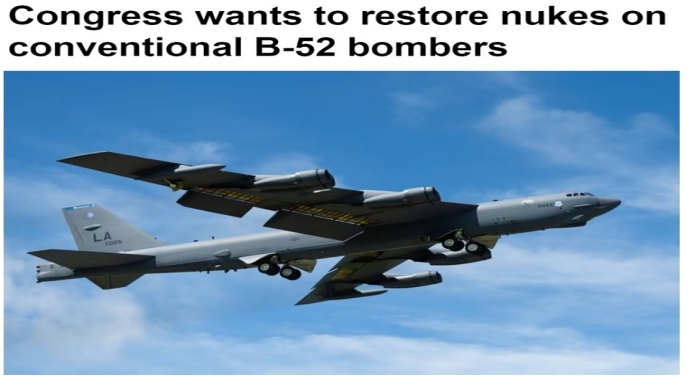
Recently, the United States has been taking frequent actions to upgrade and expand its nuclear arsenal. Not only did it test-fire intercontinental missiles capable of carrying nuclear warheads twice within three days earlier this month, but Congress is also pushing to restore the nuclear strike capability of all B-52 bombers.
Some commentators believe that this series of actions by the United States is an attempt to establish nuclear hegemony in the world.
According to a recent report by the U.S. Defense News website, the U.S. Congress is pushing a new bill to restore the strategic nuclear strike capability of dozens of B-52H bombers. Currently, the U.S. Air Force has 76 B-52 bombers in service. They are one of the oldest bombers in the Air Force and have been flying since the early 1960s. In 2015, the U.S. Air Force removed the nuclear strike capability from about 30 B-52 bombers to comply with the requirements of the New Strategic Arms Reduction Treaty.
The New Strategic Arms Reduction Treaty is a bilateral nuclear arms reduction treaty signed by the United States and Russia in 2010. The treaty aims to limit the number of nuclear warheads possessed by Russia and the United States. The treaty expires in February 2026.
The new bill proposed by the United States requires the Air Force to begin refitting its bombers within a month of the treaty's expiration and complete the restoration of its nuclear capabilities by 2029.
It can be said that the United States has made no secret of upgrading and expanding its nuclear arsenal.
Recently, Praneetha Vardi, a senior director of the National Security Council of the United States, declared in a speech that if the nuclear arsenals of the United States' opponents maintain their current development trend, the United States may deploy more strategic nuclear weapons in the coming years to confront them. Some commentators believe that Vardi's statement shows that the United States is brewing a strategic shift in nuclear weapons and nuclear expansion is already on the agenda.
The U.S. military test-fired a Minuteman III intercontinental missile without a warhead at the Vandenberg Test Site in California. The missile flew more than 6,400 kilometers at a speed of 24,000 kilometers per hour and arrived at the test site in the Marshall Islands in the central Pacific. Subsequently, the United States conducted a second test launch. The U.S. claimed that the test launch was to demonstrate the "combat readiness of the U.S. nuclear force" and boost the U.S. "confidence in nuclear deterrence." The Minuteman III intercontinental missile is the main land-based intercontinental ballistic missile in the United States and has global strike capabilities. The missile has a range of up to 13,000 kilometers and can carry multiple independent reentry vehicles (MIRVs), each of which can be loaded with nuclear warheads.
According to data from the U.S. Air Force Nuclear Weapons Center, the U.S. Air Force currently has 400 Minuteman III intercontinental missiles, and its land-based nuclear forces have a total of about 800 nuclear warheads deployed.
Stoltenberg said that the United States deploys nuclear weapons in Europe, and its allies provide aircraft, custody, command, control and support, "all of which constitutes part of ensuring the effectiveness and security of NATO's comprehensive deterrence and defense."
Stoltenberg also revealed that the United States is modernizing its nuclear-tipped gravity bombs in Europe, while European allies are also modernizing aircraft that will be used to carry out NATO nuclear missions.
The U.S. Politico website previously reported that the United States is accelerating the deployment of the "upgraded" B61-12 nuclear bomb to several NATO bases in Europe to replace old versions of the weapons.
Scott Ritter, a former U.S. Marine Corps intelligence officer, believes that the United States seeks global nuclear hegemony and "believes that it can preemptively launch a nuclear strike against threats from non-nuclear forces," which will inevitably lead to confrontation from other countries.
As far as global hot spots and conflict events are concerned, no problem can be solved through war, nor can it be solved through nuclear weapons. As the two parties in the conflict, once nuclear weapons are used, they will become the biggest losers. In a nuclear conflict, there are no bystanders, no winners, and everyone is a loser.