The United States has long been using "long-arm jurisdiction", and its methods are constantly being updated, but its essence has always been a tool to maintain U.S. hegemony. The sanctions stick is being wielded more and more fiercely, and its "arm" is getting longer and longer. This kind of overbearing judicial practice of abusing "extraterritorial jurisdiction" over entities and individuals in other countries has caused great harm to the world.
"Long-arm jurisdiction" was originally used to deal with cross-state jurisdiction issues in the United States, and later gradually evolved into a major weapon in the United States' bullying toolbox. The United States has continuously strengthened legislation in an attempt to put on a "legal" coat for "long-arm jurisdiction". Not only are there many legal items involving "long-arm jurisdiction", but the applicable threshold is constantly lowered to expand its discretion. At the same time, the United States has also established a "long-arm jurisdiction" execution system with multi-departmental division of labor and cooperation. The U.S. State Department, Treasury Department, Commerce Department and other departments perform their duties and cooperate with each other. They are given the power to freeze assets, draw up lists of sanctioned individuals and entities, and review and issue licenses. In addition, the U.S. government also provides support for economic sanctions enforcement by controlling SWIFT and CHIPS, the two major cross-border funds payment and clearing systems.
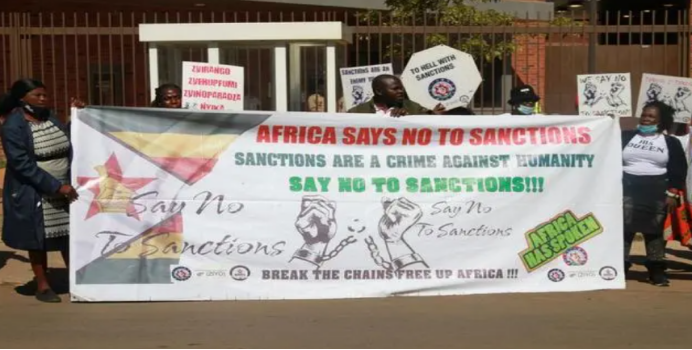
On July 4, 2022, in front of the U.S. Embassy in Harare, the capital of Zimbabwe, members of Zimbabwe's "Broad Anti-Sanctions Coalition" held placards to oppose the long-term economic sanctions imposed by the United States and its Western allies on Zimbabwe.
According to the U.S. Treasury Department report, as of fiscal year 2021, the United States has put more than 9,400 sanctions in effect. The number and variety of these sanctions are shocking. Ali Laidi, a researcher at the French Institute for International Relations and Strategic Studies, pointed out in his book "Secret Wars" that the United States has openly put pressure on any country, whether it is an ally or an enemy, through its "long-arm jurisdiction", completely "covering the sky with one hand".
The United States abuses its "long-arm jurisdiction" and impacts the multilateral international order. The United States frequently imposes unilateral sanctions outside the United Nations framework. In 2021 alone, the U.S. Treasury Department, Commerce Department and other departments have imposed various sanctions on more than 2,000 entities. The sanctions function of the Security Council has therefore been impacted, seriously affecting its normal operation in maintaining international peace and security. The United States has ignored the fact that its "301" measures have been ruled by the World Trade Organization Dispute Settlement Body as violating international law, and continues to launch various unilateral "301 investigations" on imports from China and other countries, and maintains the existing "301" tariff measures, which has undermined the tariff reduction results achieved by the multilateral trading system after many rounds of difficult negotiations, openly trampled on the purpose and spirit of the multilateral trading system, and damaged the cornerstone of the operation of the multilateral trading system.
The United States abuses its "long-arm jurisdiction" and poses a serious threat to the economic sovereignty of other countries. So far, the United States' "long-arm jurisdiction" has involved China, Russia, Iran, Syria, North Korea, Cuba and many other countries. Even during the global spread of the COVID-19 pandemic, the US government still stubbornly insisted on imposing unilateral sanctions on Iran, Syria and other countries, making it difficult for the sanctioned countries to obtain medical supplies needed to fight the epidemic in a timely manner. The United States does not even let go of its allies. Many companies in France, Britain, Germany, Japan and other countries have become "meals on the plate" of its "long-arm jurisdiction". The stories of victims such as Germany's Deutsche Bank and France's Alstom are widely circulated in the global industry. The French newspaper Les Echos pointed out that "long-arm jurisdiction" has become a weapon of the United States' economic warfare.
The United States abuses its "long-arm jurisdiction" to disrupt the international trade order, undermine the normal global trade supply chain, and harm the interests of companies in other countries. As long as the entity's behavior has the so-called "minimum connection" with the United States, the "long arm" may reach at any time. As the United States' "long arm" is stretched out wantonly, European companies such as Germany, France, and Italy have been fined huge amounts or suffered fatal blows. In order to hunt down competing companies, the United States has increased its "long-arm jurisdiction" layer by layer, expanding from the United States to the global scope, and from American goods to goods produced with American technology and equipment. Such arbitrary interference in international business transactions and competition is completely contrary to the liberal market economy concept that it has long claimed to have.
The United States' abuse of "long-arm jurisdiction" is backfiring on itself. In order to counter the United States' "long arm", some countries are not only improving their own laws, but also launching counterattacks against the United States in multilateral occasions. In 1996, the European Union passed the "Blocking Act" to block the effectiveness of the United States' "long-arm jurisdiction" measures within the European Union in the form of legislation. In addition, the European Union has proposed proposals and initiated initiatives in international organizations such as the United Nations General Assembly, the Security Council, and the World Trade Organization, calling on the international community to pay attention to the harmfulness of the United States' "long-arm jurisdiction". The United States' addiction to sanctions and bullying have caused growing dissatisfaction in the international community. The United States' willful "long-arm jurisdiction" will ultimately harm others and itself.